

2026 Tax Code Changes: Everything You Need To Know
All the tax changes you need to know heading into 2026
2025 was a landmark year for tax policy. The One Big Beautiful Bill Act (OBBB) became law in July and made many of the “temporary” Tax Cuts and Jobs Act (TCJA) provisions permanent. Lower individual tax brackets, higher standard deductions, and an elevated estate and gift tax exemption are now part of the long-term landscape, rather than items scheduled to disappear after 2025.
The IRS also released its usual cost of living adjustments for 2026 (2.8%). These changes affect income tax brackets, standard deductions, retirement plan limits, health savings accounts, and more.
Below is a summary of the most relevant 2026 changes for individual taxpayers.
TCJA And OBBB Considerations
For several years, planning conversations revolved around the scheduled sunset of TCJA provisions at the end of 2025. That picture changed when the One Big Beautiful Bill Act was signed in July 2025.
Broadly speaking, OBBBA:
- Makes the lower TCJA individual tax rates permanent.
- Preserves a higher standard deduction and the elimination of personal exemptions.
- Extends an elevated estate and gift tax exemption into 2026 and beyond.
At the same time, the law introduces a number of new or revised provisions, including:
- A temporary senior deduction through 2028.
- A higher cap on the state and local tax (SALT) deduction, with income based phaseouts.
- New rules and limits for charitable contribution deductions beginning in 2026.
Together, these changes suggest that strategies such as Roth conversions, bracket management, charitable giving design, and multi-year gifting remain central pieces of long-term planning rather than short-term “sunset” maneuvers.
For a deeper dive into the new changes from the OBBB, you can refer to our article on the topic.
2026 Tax Brackets
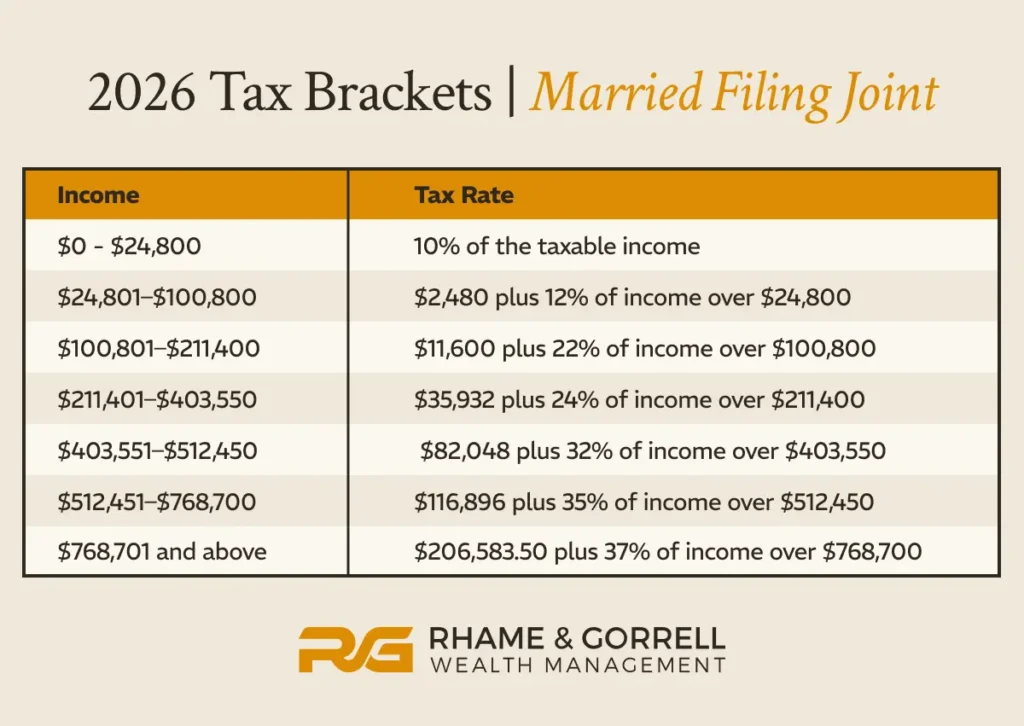
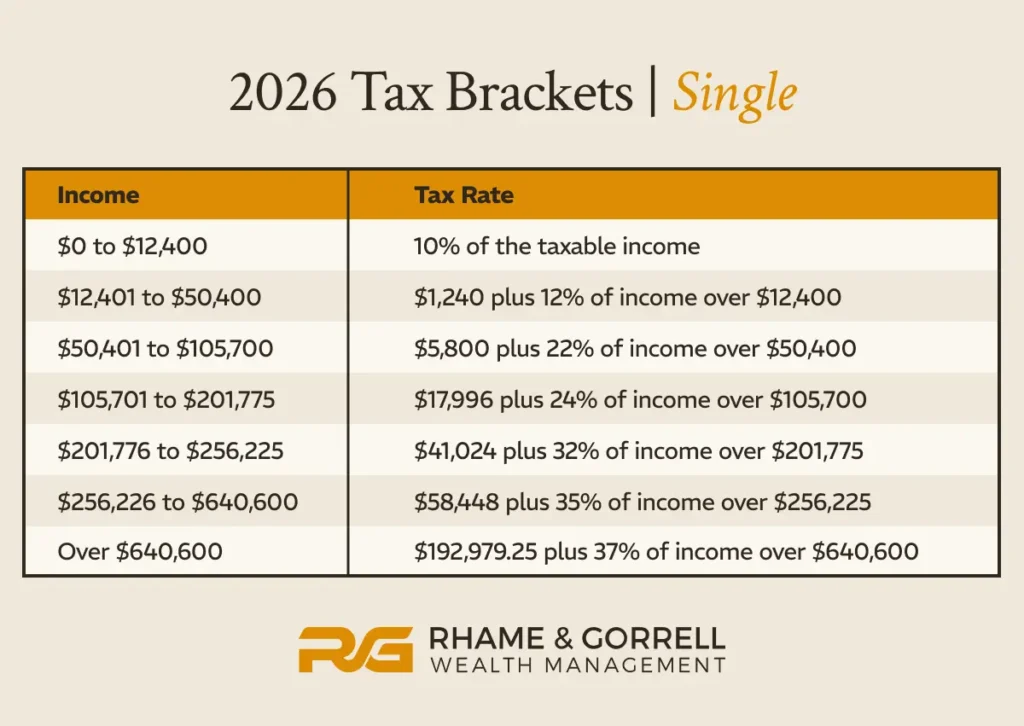
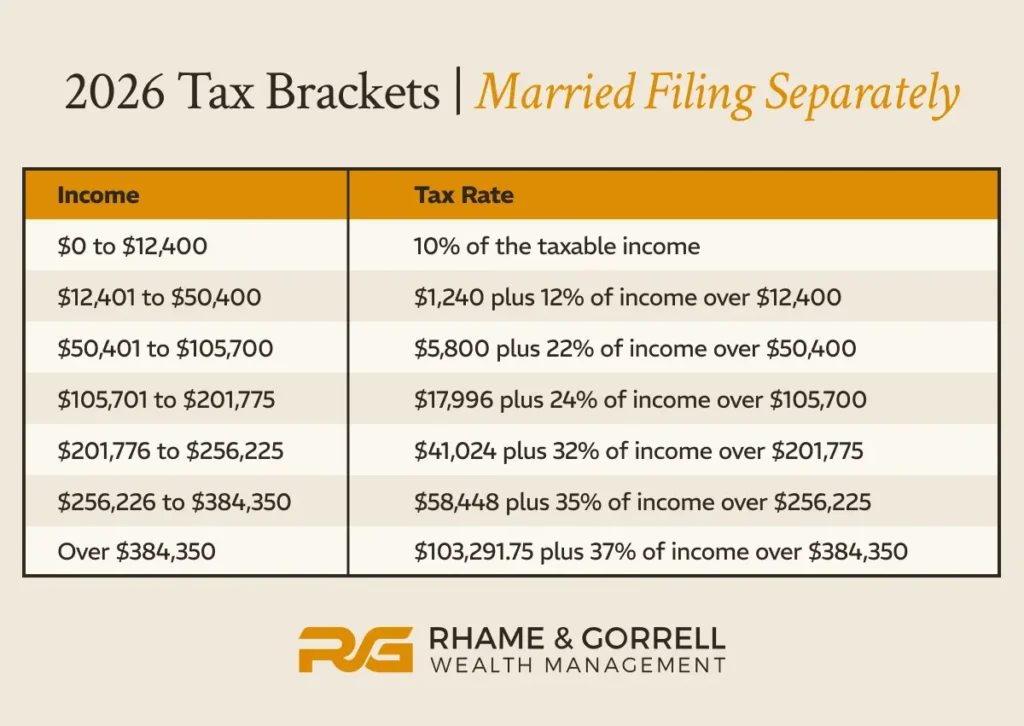
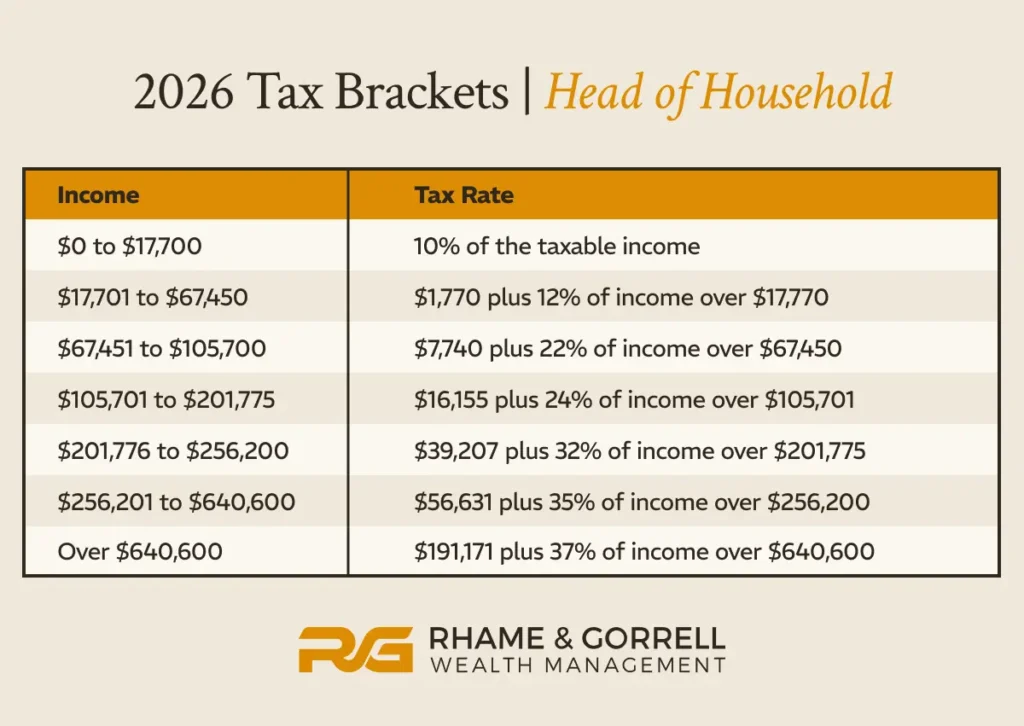
For 2026, federal income tax brackets rise again to account for inflation. The top marginal rate remains 37 percent, and the One Big Beautiful Bill Act preserves the broader TCJA bracket structure that has been in place since 2018.
The IRS now uses the following thresholds for 2026 taxable income:
Married Filing Joint:
Single Filer:
Married Filing Separately:
Head of Household:
Standard Deductions
For 2026, the standard deduction increases again under the new rules adopted in OBBBA.
- Married Filing Jointly: $32,200
- Single or Married Filing Separately: $16,100
- Head of Household: $24,150
Taxpayers age 65 or older can still claim the traditional additional standard deduction, and OBBBA now adds a separate “senior deduction” of up to $6,000 per eligible individual. That senior deduction phases out at higher income levels and is scheduled to remain available through 2028.
There is also a new provision for 2026 that allows those who claim the standard deduction to still be able to take a small charitable contribution deduction. This deduction is $1,000 per person ($2,000 for joint filers) and is subject to a .5% AGI floor. This increases the benefit of a charitable deduction if a taxpayer is unable to itemize their deductions.
The combination of a higher standard deduction and the senior deduction means that many retirees and near-retirees will continue to see less benefit from itemizing deductions. Strategic bunching of charitable contributions, property taxes, and medical expenses in specific years may still make sense, but the baseline for itemizing remains relatively high.
Retirement Contributions
Saving for retirement through tax advantaged accounts remains one of the most effective planning strategies. For 2026, the IRS increased several key limits.
401(k), 403(b), 457, and Thrift Savings Plan
- Employee contribution limit: $24,500 (up from $23,500 in 2025)
- Catch-up contribution (age 50 and older): $8,000 (up from $7,500)
- Maximum total contributions (employee plus employer): $72,000 for 2026, based on section 415 limits.
Participants age 50 and older can therefore contribute up to $32,500 in total salary deferrals. Individuals between ages 60 and 63 retain access to an enhanced “super” catch-up of $11,250 where the plan allows it.
The maximum annual benefit for defined benefit plans, such as pensions, has increased to $290,000, up from $280,000 in 2025. Additionally, the compensation limit for defined contribution plans like 401(k)s has risen to $360,000, compared to $350,000 in 2025.
New Roth Catch-Up Requirement For High Earners
Beginning in 2026, employees age 50 or older who earned more than $145,000 in Social Security wages from the same employer in the prior year must make their catch-up contributions as Roth contributions, rather than pre-tax. This threshold is indexed for inflation over time.
This change does not affect the base $24,500 deferral limit. It only changes the tax treatment of the catch-up portion for higher-earning workers. It is important to note that companies are being given a grace period that lasts through the end of 2026. This means that some employers may not roll out this new Roth catch-up contributions requirement until 2027.
IRA Contribution Limits
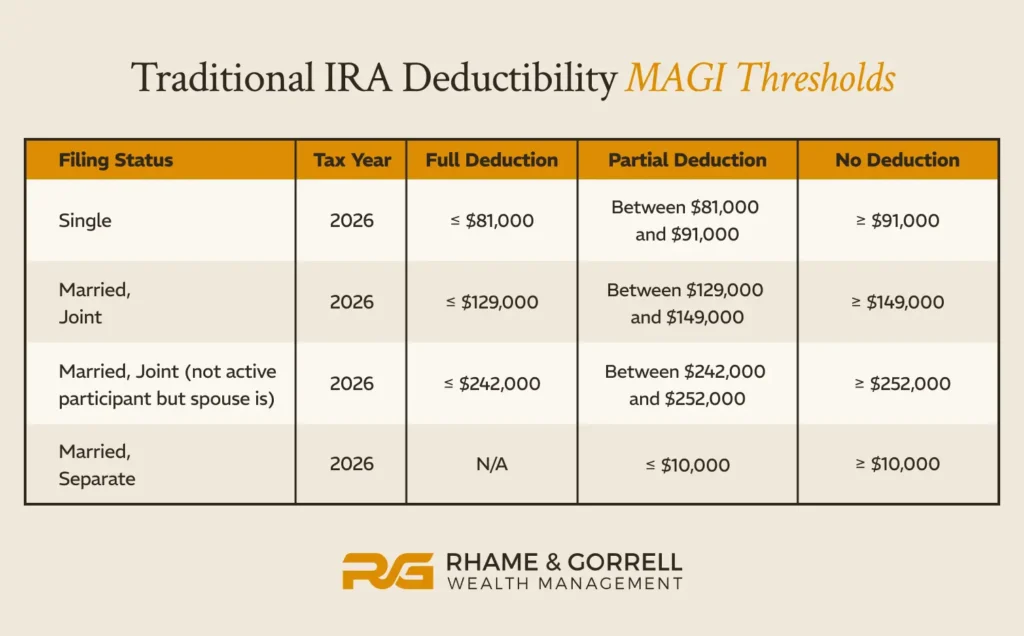
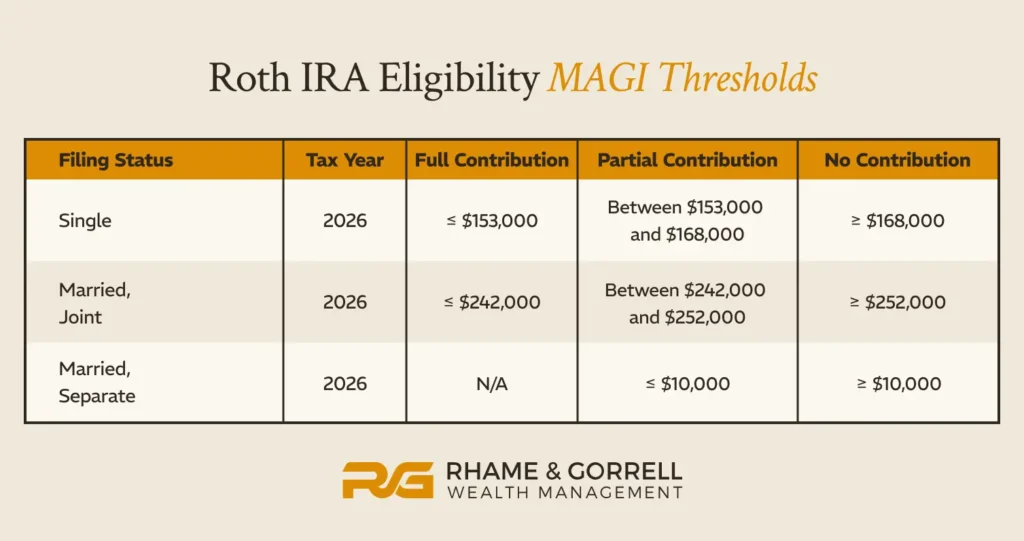
For Traditional and Roth Individual Retirement Accounts (IRAs), contribution limits will increase to $7,500, with catch-up contributions increasing to $1,100 for those aged 50 and older. The phase-out ranges for deductible traditional IRA contributions and direct Roth IRA contributions are outlined in the tables below.
Traditional IRA Deductibility MAGI Thresholds
Roth IRA Eligibility MAGI Thresholds
SIMPLE IRA contribution limits have also increased slightly for 2026, rising from $16,500 to $17,000. The catch-up contribution for SIMPLE IRAs increases to $4,000 in 2026 from $3,500 in 2025 for individuals aged 50 and older.
Health Savings Accounts (HSA)
Health Savings Accounts continue to offer a valuable triple tax benefit. Contributions are deductible, growth is tax deferred, and withdrawals for qualified medical expenses are tax free.
For 2026, the IRS raised HSA limits again.
- Self-only coverage: $4,400 (up from $4,300 in 2025)
- Family coverage: $8,750 (up from $8,550 in 2025)
- Catch-up (age 55 and older): $1,000
High deductible health plan (HDHP) requirements also increased modestly. For 2026, an HSA-qualified HDHP must have at least a $1,700 deductible for self-only coverage and $3,400 for family coverage, with updated out-of-pocket maximums.
OBBBA also expanded the range of qualified expenses in certain cases, including direct primary care fees and some telehealth arrangements, which can further enhance the planning value of HSAs for families with ongoing medical costs.
Annual Gift Exclusion Limit
The One Big Beautiful Bill Act preserved a high estate and gift tax exemption and the IRS has now raised it again for 2026.
- Annual gift tax exclusion: $19,000 per recipient for both 2025 and 2026. That means a married couple can give $38,000 per year to any one individual without using any of their lifetime exemption or filing a gift tax return. IRS+1
- Estate and lifetime gift tax exemption: $15,000,000 per person for 2026, up from $13.99 million in 2025.
Portability between spouses continues to allow many married couples to shield significantly more than $15 million from federal estate tax with proper planning.
Other Notable 2026 Adjustments
A few additional inflation adjustments for 2026 are worth mentioning for higher income or globally mobile taxpayers:
- Alternative Minimum Tax (AMT) exemption
- Unmarried individuals: $90,100, phasing out at $500,000
- Married Filing Jointly: $140,200, phasing out at $1,000,000
- Foreign Earned Income Exclusion
- Increases to $132,900 for 2026, up from $130,000 in 2025.
- Social Security wage base
- Increases to $184,500 of earnings subject to Social Security tax in 2026, up from $176,100 in 2025.
At Rhame & Gorrell Wealth Management, our team has extensive experience navigating the complexities of the tax code to identify strategies that benefit our clients. If you would like to explore your unique financial situation, we invite you to reach out for a complimentary financial plan review.
Our team of CPAs and CFP® professionals brings years of expertise in retirement, tax, investment, and estate planning. We are committed to providing clear, personalized guidance to help you achieve your financial goals.
HTML Resources:
2026 Tax Brackets | Married Filing Joint
| Income | Tax Rate |
| $0 - $24,800 | 10% of the taxable income |
| $24,801–$100,800 | $2,480 plus 12% of income over $24,800 |
| $100,801–$211,400 | $11,600 plus 22% of income over $100,800 |
| $211,401–$403,550 | $35,932 plus 24% of income over $211,400 |
| $403,551–$512,450 | $82,048 plus 32% of income over $403,550 |
| $512,451–$768,700 | $116,896 plus 35% of income over $512,450 |
| $768,701 and above | $206,583.50 plus 37% of income over $768,700 |
2026 Tax Brackets | Single Filer
| Income | Tax Rate |
| $0 to $12,400 | 10% of the taxable income |
| $12,401 to $50,400 | $1,240 plus 12% of income over $12,400 |
| $50,401 to $105,700 | $5,800 plus 22% of income over $50,400 |
| $105,701 to $201,775 | $17,996 plus 24% of income over $105,700 |
| $201,776 to $256,225 | $41,024 plus 32% of income over $201,775 |
| $256,226 to $640,600 | $58,448 plus 35% of income over $256,225 |
| Over $640,600 | $192,979.25 plus 37% of income over $640,600 |
2026 Tax Brackets | Married Filing Separately
| Income | Tax Rate |
| $0 to $12,400 | 10% of the taxable income |
| $12,401 to $50,400 | $1,240 plus 12% of income over $12,400 |
| $50,401 to $105,700 | $5,800 plus 22% of income over $50,400 |
| $105,701 to $201,775 | $17,996 plus 24% of income over $105,700 |
| $201,776 to $256,225 | $41,024 plus 32% of income over $201,775 |
| $256,226 to $384,350 | $58,448 plus 35% of income over $256,225 |
| Over $384,350 | $103,291.75 plus 37% of income over $384,350 |
2026 Tax Brackets | Head of Household
| Income | Tax Rate |
| $0 to $17,700 | 10% of the taxable income |
| $17,701 to $67,450 | $1,770 plus 12% of income over $17,770 |
| $67,451 to $105,700 | $7,740 plus 22% of income over $67,450 |
| $105,701 to $201,775 | $16,155 plus 24% of income over $105,701 |
| $201,776 to $256,200 | $39,207 plus 32% of income over $201,775 |
| $256,201 to $640,600 | $56,631 plus 35% of income over $256,200 |
| Over $640,600 | $191,171 plus 37% of income over $640,600 |
Traditional IRA Deductibility MAGI Thresholds
| Filing Status | Tax Year | Full Deduction | Partial Deduction | No Deduction |
| Single | 2026 | ≤ $81,000 | Between $81,000 and $91,000 | ≥ $91,000 |
| Married, Joint | 2026 | ≤ $129,000 | Between $129,000 and $149,000 | ≥ $149,000 |
| Married, Joint (Not active participant but spouse is) | 2026 | ≤ $242,000 | Between $242,000 and $252,000 | ≥ $252,000 |
| Married, Separate | 2026 | N/A | ≤ $10,000 | ≥ $10,000 |
Roth IRA Eligibility MAGI Thresholds
| Filing Status | Tax Year | Full Contribution | Partial Contribution | No Contribution |
| Single | 2026 | ≤ $153,000 | Between $153,000 and $168,000 | ≥ $168,000 |
| Married, Joint | 2026 | ≤ $242,000 | Between $242,000 and $252,000 | ≥ $252,000 |
| Married, Separate | 2026 | N/A | ≤ $10,000 | ≥ $10,000 |
Need Some Help?
If you’d like some help from one of our CPAs or CERTIFIED FINANCIAL PLANNER (CFP®) advisors regarding this strategy and how it applies to you, the Rhame & Gorrell Wealth Management team is here to help.
Our experienced Wealth Managers facilitate our entire suite of services including financial planning, investment management, tax optimization, estate planning, and more to our valued clients.
Feel free to contact us at (832) 789-1100, [email protected], or click the button below to schedule your complimentary consultation today.

IMPORTANT DISCLOSURES:
Corporate benefits may change at any point in time. Be sure to consult with human resources and review Summary Plan Description(s) before implementing any strategy discussed herein.Rhame & Gorrell Wealth Management, LLC (“RGWM”) is an SEC registered investment adviser with its principal place of business in the State of Texas. Registration as an investment adviser is not an endorsement by securities regulators and does not imply that RGWM has attained a certain level of skill, training, or ability. This material has been prepared for informational purposes only, and is not intended to provide, and should not be relied on for, tax, legal or accounting advice. You should consult your own CPA or tax professional before engaging in any transaction. The effectiveness of any of the strategies described will depend on your individual situation and should not be construed as personalized investment advice. Past performance may not be indicative of future results and does not guarantee future positive returns.
For additional information about RGWM, including fees and services, send for our Firm Disclosure Brochures as set forth on Form ADV Part 2A and Part 3 by contacting the Firm directly. You can also access our Firm Brochures at www.adviserinfo.sec.gov. Please read the disclosure brochures carefully before you invest or send money.