
Market Update – March 2026
Despite a steady drumbeat of geopolitical escalation, inflation concerns, and shifting macro expectations, equity markets have shown notable resilience, with only modest declines year-to-date even as volatility has briefly surged. Beneath the surface, however, market dynamics have shifted meaningfully, with sharp sector and regional dispersion giving way to a renewed preference for U.S. large-cap quality amid rising uncertainty tied to the Iran conflict and energy markets.
The surge in oil prices and disruption in the Strait of Hormuz represent the clearest near-term risk to both inflation and global growth, though current pricing suggests markets expect these pressures to be temporary rather than structurally damaging.
At the same time, economic data points to a slowing but stable U.S. economy with contained inflation, steady labor markets, and monetary policy retaining a cautiously accommodative bias. While risks have undeniably increased, the underlying strength of corporate earnings and the broader economic foundation continue to support a base case of cautious optimism as markets navigate this period of heightened uncertainty.
Market Summary
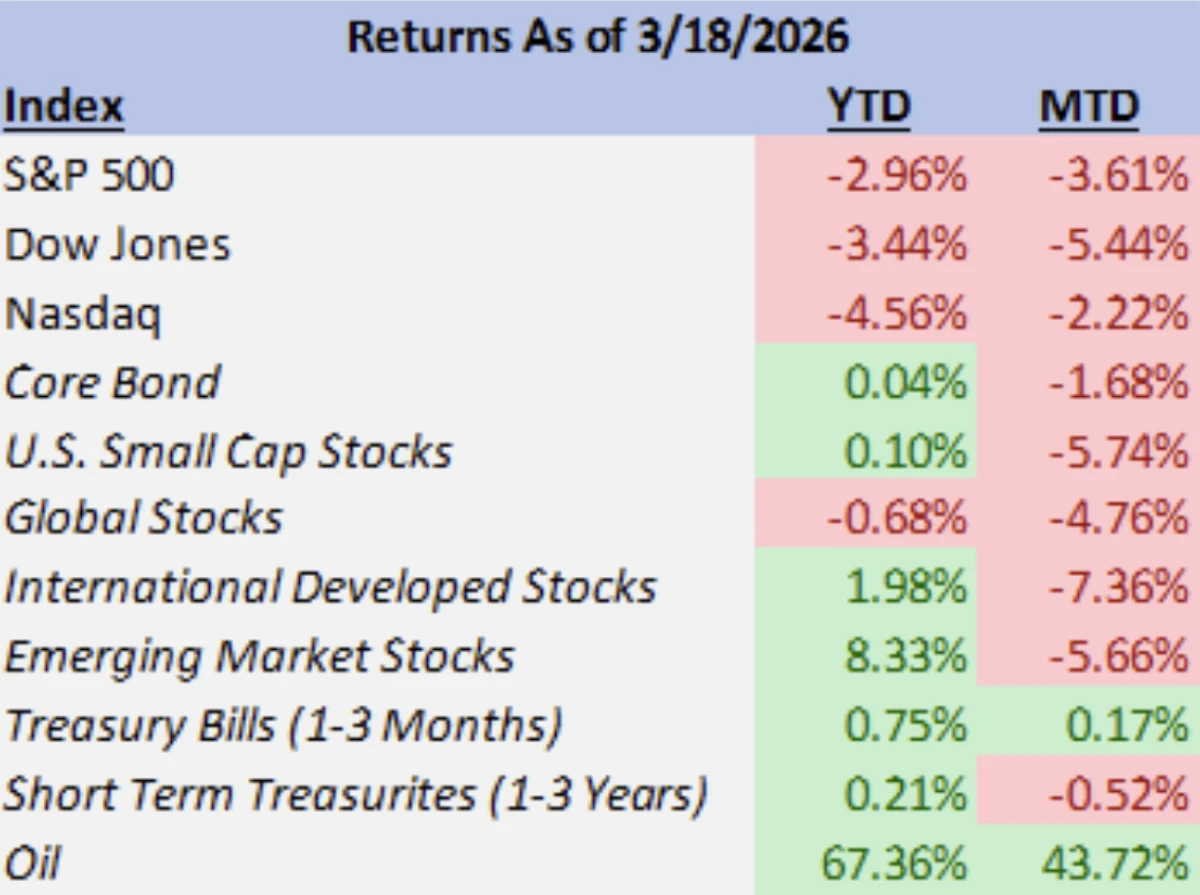
As mentioned in our introduction, the market has moved just modestly lower year-to-date despite a seemingly cascading set of factors and risks emerging as headwinds. Since the initiation of this year’s strikes on Iran, the S&P 500 has fallen just -3.6%. This downward move represents a decline of -5.6% from the index’s all-time high.
Perhaps in essence capturing the disconnect of how bad things are versus how bad things feel, the VIX volatility index spiked to its highest level since last year’s April “Liberation Day” tariff selloff; briefly surging to a high of over 35 before closing at 25.5 on the same day.
As a reminder, the VIX measures the market’s expectation of 30-day volatility for the S&P 500 (through a weighted average of option prices), a “high” VIX (often considered a value above 30) indicates heightened market uncertainty and fear while a “low” VIX (a value below 20) indicates high stability and low volatility. As of the most recent close, the VIX is valued at 25.09. Last April, the VIX rose to a high of 60.13.

While the pain to the overall S&P 500 index has been subdued to this point, there continues to be significant dispersion among the underlying sectors. The energy sector, which had already started the year strong, has continued to move higher since the onset of the conflict in Iran, having produced a year-to-date return of ~31%.
This sector has proven to be among the singular sectors and even asset classes to have continued its upward trend post-Iranian conflict commencement. Other sectors that had bullishly moved year-to-date up to the conflict’s escalation, including materials (~6.3% YTD), consumer staples (~7.4% YTD), and industrials (~6.5% YTD), have seen significant downward reversals.
Meanwhile, technology and communications services, which going into the conflict had struggled relative to peers year-to-date, have outperformed the overall S&P 500 since the U.S.’s strikes. Technology, while still negative on the year (-6.3% YTD), is negative by less than one percent (-0.8% MTD) for the month.
A similar narrative can be expressed for how the U.S. large cap equity market has performed relative to other regions and market caps. Year-to-date, emerging market equities (~8.3% YTD), international equities (~2% YTD), and small cap stocks (0.1% YTD) continue to outperform their S&P 500 counterparts, but that performance gap has narrowed considerably.
Since the war’s onset ending February, the Russell 2000 (US small cap stocks) has slipped -5.7%. Foreign equity markets have fared even worse, with international developed stocks (-7.4% MTD) and emerging market equities (-5.7% MTD) each notching declines greater than their U.S. large cap counterparts.
While how long this reversal in year-to-date performance trends lasts remains unknown to this point, we do see them as rooted in reason. Geopolitical risk, inflationary concerns, and uncertainty over the trajectory of global economic growth have risen significantly over the course of the month due to both the onset of the war in Iran and recent economic reports.
Market leadership through February, with small caps, foreign stocks, and value-oriented equity sectors outperforming, suggested a narrowing of earnings growth differentials from the U.S. dominated mega cap growth companies relative to the rest of the market, a weakening of the dollar, and higher broad global economic growth.
Now that war has arrived along with its concerning economic realities (effective closure of the Strait of Hormuz), the prospects of what was expected to be accelerating economic growth and declining inflation have not only been put on pause but now appear to be at risk. With this emerging doubt in the economic backdrop has come a bid for quality investment positioning, exhibited by a preference for U.S. mega cap equities, technology bellwethers, and with them the U.S. dollar as a safe haven currency.
Since the U.S.’s strike on Iran at the end of February, the U.S. dollar has seen a significant rally, with the DXY (the general dollar strength index) rising ~2.4 points to a value of over 100; this represents a 2.5% gain and is the first time DXY has been over 100 since late November 2025.
Although there are real signs of this “flight to quality” exhibited above, the inflationary concerns stemming from the war induced oil spike in the Middle East has forced investors to reconsider their fixed income positioning as it pertains to both duration and credit quality. There has been a marginal widening in credit spreads across both investment grade corporate and high yield bonds relative to their government bond counterparts. The moves have not yet reached crisis thresholds, but they do signify a degradation in market participants’ perception of the economic backdrop.
At the same time, the yield curve for US treasuries has seen an upward shift across all maturities as the Strait of Hormuz’s traffic standstill has reinvigorated inflationary concerns and cast doubt on what previously was expected to be a resumption in the interest rate cutting cycle in the second half of the year. The rise in bond yields has been increasingly larger in magnitude the further one goes out in maturity.

U.S. Treasury Yield Curve (1M-30Y Maturities) March 18 vs February 27- Bloomberg
The Iran War, Strait of Hormuz, and Market Impacts
Since the onset of the war there have been 13 U.S. service members killed and approximately 200 wounded (180 troops having returned to duty). We are grateful for the service and sacrifice of these individuals. Beyond the economic data we analyze, there is a profound human toll to this conflict. While we move into a discussion on how these developments impact the global economy, we do so with a clear recognition of the lives lost and the families upended.
We acknowledge that we are not experts on warfare, geopolitical strategy, or diplomacy. However, we will do our best to provide a rational assessment of the current state of the conflict and its impacts on global markets.
Since the onset of the war at the end of February, WTI crude oil has surged from nearly 44% or ~$29 from a price of $67.02 to a price (as of 3/18) of $96.32. The commodity, an economic lifeblood for the world, has breached $100 at times and displayed historic levels of volatility; over the course of a single trading session, WTI approached a high of nearly $120, fell as low as ~$81, before closing at $94.77, just $3.33 off of where it opened. To say that the trading in oil has been volatile would be an understatement.
While no one can deny that the price of oil is significantly higher than where it was prior to the war, the prognosis for its likely impacts on the global economy, and in turn the markets, widely differs based upon one’s expectation for the length of time oil will remain at these high levels. The oil market has seen a dramatic exaggeration of “backwardation”, a phenomenon where the prices for shorter-dated contracts are higher than those further out in the future.
These dynamics are not in themselves uncommon, as storage costs and convenience yields make oil market backwardation a fairly natural state. However, in times of supply shortages and disruptions stemming from geopolitical crises, strong current demand overpowers an immediate severe supply shortage resulting in a spike in price on the front-month contracts.
Our base assumption is that the current tensions will resolve over the coming weeks and months, conditions will normalize, and prices will fall from their present level. This strong backwardation configuration can be seen below through the current price of WTI crude in comparison to 12-month and 24-month futures strips (weighted averages of multiple futures contracts across time) in the same commodity.

WTI Oil Futures (Current, 12 Month Strips, 24 Month Strips) Over 1 Year- Bloomberg
What this tells us is that oil markets are currently elevated but are expected to fall in value over the course of the next two years back into the 70’s. This can further be expressed through the WTI March 2027 contract currently priced at $74.88. Obviously, these prices in the future describe a world where oil remains significantly higher than it was prior to the Iran war; however, it is important to consider that commodity markets, just like all risk markets, price in embedded risk premiums for uncertainty.
Uncertainty over the duration of the war with Iran alone causes the price of oil to rise across multiple contract dates across the curve. While frictions to supply and higher geopolitical risk premiums could remain above prior levels after the war’s conclusion, they almost certainly will be lower than where they are now.
With oil where it is at the moment and concerns having been reignited over inflation, an important question to ask is “what price of oil is high enough to break the economy?” A study by economists at Vanguard, published in March, postulates that oil prices sustained above $125 for the remainder of the year (alongside other coinciding extended energy price spikes) would trim a percentage point off of the European economy’s GDP and drag the economy into recession.
Separate from the study, it was also noted that costs of extended higher oil prices would be most negatively impactful to the European and Japanese economies when compared to that of the U.S.
The same analysis on the European economy, showed that the U.S. stood more resilient in the face of energy shocks.
It was modeled that oil prices reaching and staying above $150 per barrel would need to occur alongside worsening financial conditions and asset price declines before a recession is induced. A similar survey of economists conducted by the Wall Street Journal found that a slightly lower price of $138 would need to be held for 14 weeks before tilting the odds of a U.S. recession above 50%.
These observations make sense given how much more oil is sourced from the Strait of Hormuz by many countries outside of the United States. Between 70-75% of oil imports for Japan are sourced from the Strait compared to 10-20% of imports for the European Union and just 7-8% of the United States’ oil consumption needs.
The United States also finds resiliency in the position of being a net exporter of total petroleum. While this helps, GDP in the United States is still most prominently consumption-oriented – higher oil prices lead to inflation which could ultimately erode consumer strength.
Although the price of oil in both WTI and Brent is currently below the thresholds outlined by Vanguard as a point of recessionary concern, market participants (exhibited through current prices in both oil and equities) likely still maintain a view that the current war in Iran will not result in a multi month halt in traffic through the Strait of Hormuz.
This underlying assumption is the most critical one as it pertains to the health of the global economy and the continued relative resilience of equity markets in the face of the current conflict.
The United States and other global governments have made some ambitious efforts in attempting to stabilize near-term energy supply and incentivize shipping through the Strait. There was an International Energy Agency (IEA) coordinated release of over 400 million barrels of oil from participating countries’ strategic petroleum reserves, including the U.S. committing roughly 172-200 million barrels.
The U.S. has also eased sanctions on Russian oil for specific allies such as India, has temporarily lifted the U.S. Jones Act to allow foreign vessels to transport energy between U.S. ports, and has even continued allowing Iranian oil tankers to pass through the Strait.
Among the most ambitious policies employed has been the U.S. government stepping in effectively as an “insurer of last resort” in the Persian Gulf. The U.S. International Development Finance Corporation (DFC), an agency that partners with private sector entities as a foreign policy development bank, deployed a $20 billion maritime reinsurance plan to cover commercia vessels navigating the Strait of Hormuz.
While these efforts have brought some initial stability, the problem in the Strait still remains. As of March 15th, at least 89 ships (including 16 oil tankers) have crossed the Strait since the start of the Iran war. Among these vessels have been “dark ships”, or vessels that deliberately turn off their transponders to hide location, identity, and cargo for various evasive (often illegal) purposes; these ships have often been tied to Russian, Iranian, and Chinese origin.
Of the 89 vessels, more than one fifth are believed to be Iran-affiliated while Chinese, Greek, Pakistani, and Indian were among the rest. The 89 ships over a 15-day period is a steep drop-off from the estimated 100-135 ships that passed daily before the war.
The U.S. Navy has yet to begin escorting ships through the Strait of Hormuz, with the focus currently being on taking out military assets in the high-risk region that could be used to conduct drone, missile, and small boat attacks on Navy assets and freight ships alike.
Despite the DFC having provided a backstop to the insurance market, currently cargo ship captains are understandably hesitant to put their ships, crews, and own lives at risk. It is becoming clear that before shipping through the region resumes, either a ceasefire in the Strait must be reached or Iranian abilities to attack shipping in the region must be debilitated to a point of high confidence.
In a March 13th statement from the US Department of War, Secretary of War Pete Hegseth, stated that the U.S. and Israeli air forces have struck over 15,000 enemy targets. Furthermore, Iran’s missile launch volume is down 90% and one-way drone attacks are down 95% since the first day of Operation Epic Fury.
Among those targets destroyed have been nuclear facilities, military and IRGC bases, missile, drone, and air defense infrastructure, naval assets, and leadership buildings. Among those targets in the first 10 days included 120 Iranian ships sunk or damaged, 36 military bases, and 26 missile launch sites. If one gauges progress in the conflict off of Iran’s ability to retaliate through organized naval, air, missile, and drone attacks, then this decline in the volume of strikes clearly shows a degradation in that ability.
In a recent note from Institute For the Study of War, a non-partisan public policy research organization, they declared that “the war in Iran is currently in a phase in which military trajectory is relatively positive.” However, they also have described Iran’s own strategy as to inflict “enough political and economic pain upon the United States, Israel, and America’s Gulf allies” as to “make the combined force cease its operation”.
Along with their attempts to attack both the U.S. and Israel’s military targets, and the Israeli homeland, this strategy has been most notably seen through Iran’s attempt to inflict heavy costs upon nearby Middle Eastern countries such as Saudi Arabia, the United Arab Emirates, Qatar, Bahrain, and others.
Those targets have most recently included key energy infrastructure, most recently gas facilities in Qatar and Saudi Arabia. The fronts of the war have also expanded to Lebanon as Israel has engaged the Iranian proxy group Hezbollah following their resumption of rocket attacks on Israel.
While Iran’s ability to conduct large scale organized warfare has been greatly weakened by the U.S. and Israeli military’s campaign, simply leaving this conflict with the regime having maintained power over the country may be seen as a victory in their view. Sowing enough regional chaos and inflicting high enough economic costs could be enough pressure over time to lead the U.S. to end its military campaign, so long as there are guarantees for the Strait of Hormuz to be reopened.
The question ultimately becomes whether the U.S. and Israel’s large scale military efforts have reduced the Iranian regime’s ability to maintain control to the point where the Iranian people will rebel and expel the regime from power. The Israeli military have made attempts through targeting Iranian military and government leadership and even local IRGC enforcement personnel, likely to prepare the groundwork for such a rebellion to occur.
In one of the most recent attempts to gain further economic leverage over the regime, the U.S. conducted air strikes on military targets on Kharg Island last weekend. The island is Iran’s oil export hub in the Persian Gulf. The oil assets were stated to be untouched, but President Trump has explicitly threatened that as not off the table.
There is some belief that the U.S. could attempt to outright capture the island, which is responsible for 90% of Iran’s oil exports. Halting oil flows from the island would put even more pressure on the global oil supply chain but could also make the Iranian regime’s ability to conduct war and its own existence economically unsustainable.
Ultimately, any forecast of where the Iran war goes from here and for how long should not be made with a high degree of confidence. The Trump administration initially projected a 4-5 week timeline to complete target objectives, but also stated the capability to go longer. In our mind, for the economy and markets, the Strait of Hormuz remains the obvious key risk to follow. If shipping movement begins to recover and a return to normal traffic becomes the expectation, this would be a strong tailwind to global markets.
As a final note, we return to a graphic we have shared before from JP Morgan on the historical impact of geopolitical events on equity market returns. These events cover Germany’s invasion of France in 1940 all the way through Russia’s invasion of Ukraine in 2022. The data shows that returns for equities are muted for the first 3-months following the conflict but have on average returned to historical all-time averages by the 6-months following the events.

The risks to markets from these events, especially one as economically sensitive as the Iran war, are real, but so are the fundamentals underpinning the broader economy and corporate profits.
Economic Update
Although there are many concerns surrounding inflationary pressures from rising oil prices, it is important to keep in mind that while these risks are prevalent, they have not yet been realized. However, the longer the conflict continues, the more likely these supply shocks to the market will impact the real economy.
Though these higher energy costs have not yet fully flowed downstream, inflation is currently holding steady, with only a slight acceleration of annual CPI rising 0.3% in February from 0.2% in January. Core CPI on the other hand decelerated to 0.2% in February from 0.3% in January, implying we are still seeing most of the increase in prices from food and shelter costs.
The shelter index rose 0.2% in February, and remains the largest contributor to monthly headline increases, while food inflation stood at 3.1% annually, with monthly costs rising 0.4% in February.
The Producer Price Index (PPI) surged to 3.4% YoY in February, the highest level in a year. This implies that the majority of inflationary pressures from tariffs are still being paid by producers, and it is uncertain whether or not we have seen the full extent of the impacts to prices for the consumer.
Earlier this year, the supreme court declared the President Trump’s broad tariffs under the International Emergency Economic Powers Act (IEEPA) illegal in the ruling Learning Resources, Inc. V. United States, causing the administration to utilize other acts such as Section 232 under the Trade Expansion Act of 1962 and Section 301 under the Trade Act of 1974 in order to implement the original tariff policy they had set.
However, the tariffs they implemented to replace their original tariff revenue have decreased, which could lead to a decrease in inflationary pressure later this year.
While growth in 2025 decelerated to 2.1% from 2.8% in 2024, the Atlanta Fed has projected an estimated rebound of 2.7% in the current quarter, with a forecast of 2.5% year-over-year growth in 2026. Real GDP growth for Q4 2025 was revised from 1.4% downward to an annualized rate of 0.7%, a significant drop from the 4.4% growth seen in Q3. Much of this deceleration is likely due to the 43-day government shutdown, which is estimated to have reduced Q4 growth by roughly 1%.
Unemployment remains at roughly 4.4%, suggesting we are still in a “low-hire, low-fire” environment. Though there was a loss of 92,000 jobs in February, far below consensus expectations, the data is largely pointing to temporary labor disruptions such as healthcare strikes and severe weather conditions rather than permanent layoffs as the cause of job losses.
In summary, the U.S. economy is seeing steady inflation with food and shelter costs as the primary contributors, a labor market holding firm, and growth that is still positive but decelerating in recent months. All of this points to a scenario with continued stable growth and inflation coming closer to the Fed’s 2% target, but with a risk that economic spillover from the war in Iran could further diminish what has been a less potent economy in recent months.
While this is a risk to be wary of, current data compared to historical cases suggests a sturdier economic foundation more resilient to the present potential economic shock. The U.S. has relatively low unemployment and wage growth that is projected at 3.7%, a far cry from the upward spiral of 8% unemployment previous eras such as the 1970s oil crisis have seen.
Unemployment is a lagging indicator of the economic cycle, but the job market in our view has not yet shown clear signs of anything beyond a speedbump in recent economic activity. Stagflationary concerns are valid, but the health and makeup of the U.S. economy should be able to withstand the current set of pressures, especially if deescalation of conditions in the Strait of Hormuz appear on the horizon.
As a final note on the Federal Reserve, the central bank elected to leave rates unchanged during their March meeting this week. Importantly, the Fed’s updated dot plot suggested a rate cut could still be on the calendar in 2026, despite obvious concerns over the economic fallout from the Middle East.
Not much was provided from the meeting or press conference to alleviate what is now an even more uncertain situation for ongoing policy decisions given the slightly weaker economic backdrop and emerging war in Iran. However, the inclusion of a rate cut in the dot plot does indicate a continued bias towards dovishness.

Federal Reserve Dot Plot Projections and Comparables (March 18, 2026)- Bloomberg
Fed funds futures markets, a gauge of the market’s expectations for future interest rates, are pricing in a more hawkish Fed for 2026, with no rate cuts currently priced in for the year. Despite the concerns over the inflationary impacts of the ongoing war, we tend to lean closer to the Fed’s own dot plot projections here.
If the conflict finds resolution, or at least the Strait of Hormuz resumes to some normalcy of traffic, then the current shakiness of the labor market suggests that prior expectations for at least one rate cut on the year should remain the base case. Lower expectations for interest rates should result in a modest rally in bonds (especially of shorter maturities) and could provide a tailwind for equity markets once priced in.
Conclusion
While the economy has demonstrated some evidence of softening and the U.S. war with Iran has brought on heightened risks, earnings for the S&P 500 solidified that the stock market entered 2026 on strong footing. The index in aggregate produced double-digit earnings growth for the fifth consecutive quarter, along with 9% sales growth, both beating analyst estimates going into earnings season. Expectations for Q1 of this year have been revised down modestly, but analysts (per Factset) continue to anticipate a sixth consecutive quarter of double-digit growth.
Our level of conviction has been lowered due to the emergent risks of the conflict in the Middle East and the most recent economic data releases, however our base case continues to lean towards cautious optimism that markets will find their footing and resume a trajectory reflecting the strong fundamentals leading into the year.
A resolution that sees traffic resume in the Strait of Hormuz, a continuation of the rate-cutting cycle, and a recovery in economic growth (which continues to have strong tailwinds from A.I. related investment) present strong potential tailwinds for equities as we move towards the middle of the year.
This final chart from First Trust displays the stunning resiliency of the U.S. stock market, and the ability of the American corporate sphere to continue to generate profitability and gains through a history filled with moments of uncertainty produced by both crisis and innovation.

Need Some Help?
If you’d like some help from one of our CPAs or CERTIFIED FINANCIAL PLANNER (CFP®) advisors regarding this strategy and how it applies to you, the Rhame & Gorrell Wealth Management team is here to help.
Our experienced Wealth Managers facilitate our entire suite of services including financial planning, investment management, tax optimization, estate planning, and more to our valued clients.
Feel free to contact us at (832) 789-1100, [email protected], or click the button below to schedule your complimentary consultation today.

IMPORTANT DISCLOSURES:
Corporate benefits may change at any point in time. Be sure to consult with human resources and review Summary Plan Description(s) before implementing any strategy discussed herein.Rhame & Gorrell Wealth Management, LLC (“RGWM”) is an SEC registered investment adviser with its principal place of business in the State of Texas. Registration as an investment adviser is not an endorsement by securities regulators and does not imply that RGWM has attained a certain level of skill, training, or ability. This material has been prepared for informational purposes only, and is not intended to provide, and should not be relied on for, tax, legal or accounting advice. You should consult your own CPA or tax professional before engaging in any transaction. The effectiveness of any of the strategies described will depend on your individual situation and should not be construed as personalized investment advice. Past performance may not be indicative of future results and does not guarantee future positive returns.
For additional information about RGWM, including fees and services, send for our Firm Disclosure Brochures as set forth on Form ADV Part 2A and Part 3 by contacting the Firm directly. You can also access our Firm Brochures at www.adviserinfo.sec.gov. Please read the disclosure brochures carefully before you invest or send money.
![[Webinar Replay] Maximizing Your Business Sale: Strategies for Success](https://rgwealth.com/wp-content/uploads/2024/06/Insights-Maximizing-Your-business-Sale_-Strategies-for-Success-Webinar-480x270.webp "[Webinar Replay] Maximizing Your Business Sale: Strategies for Success")