
Market Update – April 2026
Global equity markets have demonstrated notable resilience in 2026, with the S&P 500 reaching new all-time highs despite a volatile backdrop driven by geopolitical tensions, energy price shocks, and shifting macro expectations. Following a ~9% correction stemming from the U.S.’s war with Iran, markets stabilized at key technical levels and have since recovered.
This recovery being supported by improving financial conditions and renewed leadership from growth-oriented sectors. At the same time, broader participation remains evident, with strength in small caps and international equities reinforcing a more diversified market advance.
While risks persist, including a fragile Middle East ceasefire, evolving inflation dynamics, and uncertainty around monetary policy, healthy corporate earnings and balanced economic data continue to point toward underlying stability. In this environment, markets appear to be climbing a familiar “wall of worry,” with investor sentiment cautious but fundamentals providing a constructive foundation for bull market continuation.
Market Summary
As mentioned earlier, the S&P 500 closed above the 7000 mark for the first time, while also notching its first all-time high since January. A more volatile selloff following some initial A.I.-driven trepidations was ignited by the Iran war and accompanying oil price surge; the correction saw the large-cap U.S. stock benchmark fall ~9% from its January highs to its low at the end of March.
The lows on the index found a bottom at the 300-day moving average, a commonly recurring point of stability during market corrections. Since the 1980s, drawdowns of greater than 5% have happened in every year but two, while the average maximum drawdown in a calendar year is about 15%.
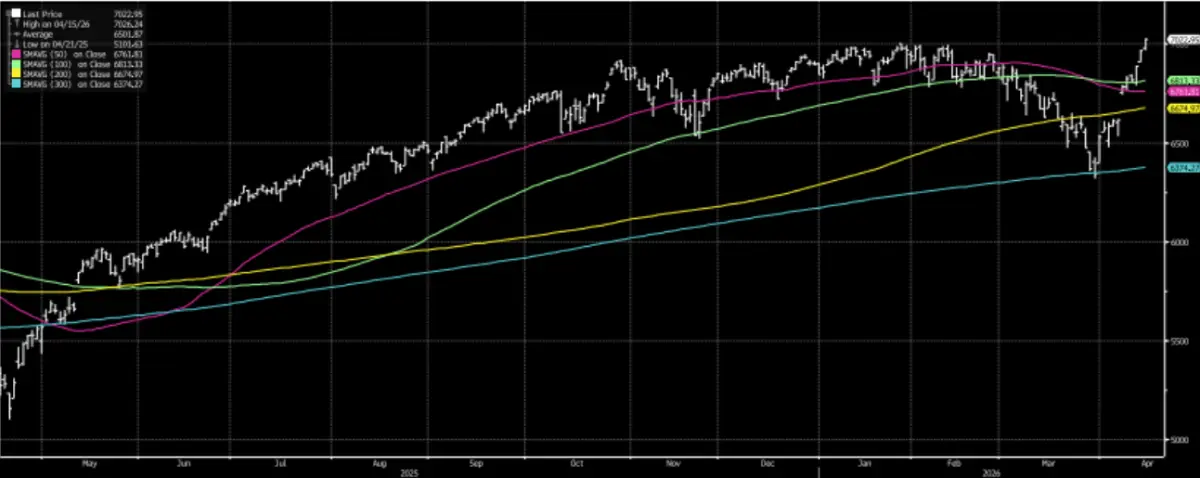
S&P 500 Price Chart (1 Year)- Bloomberg
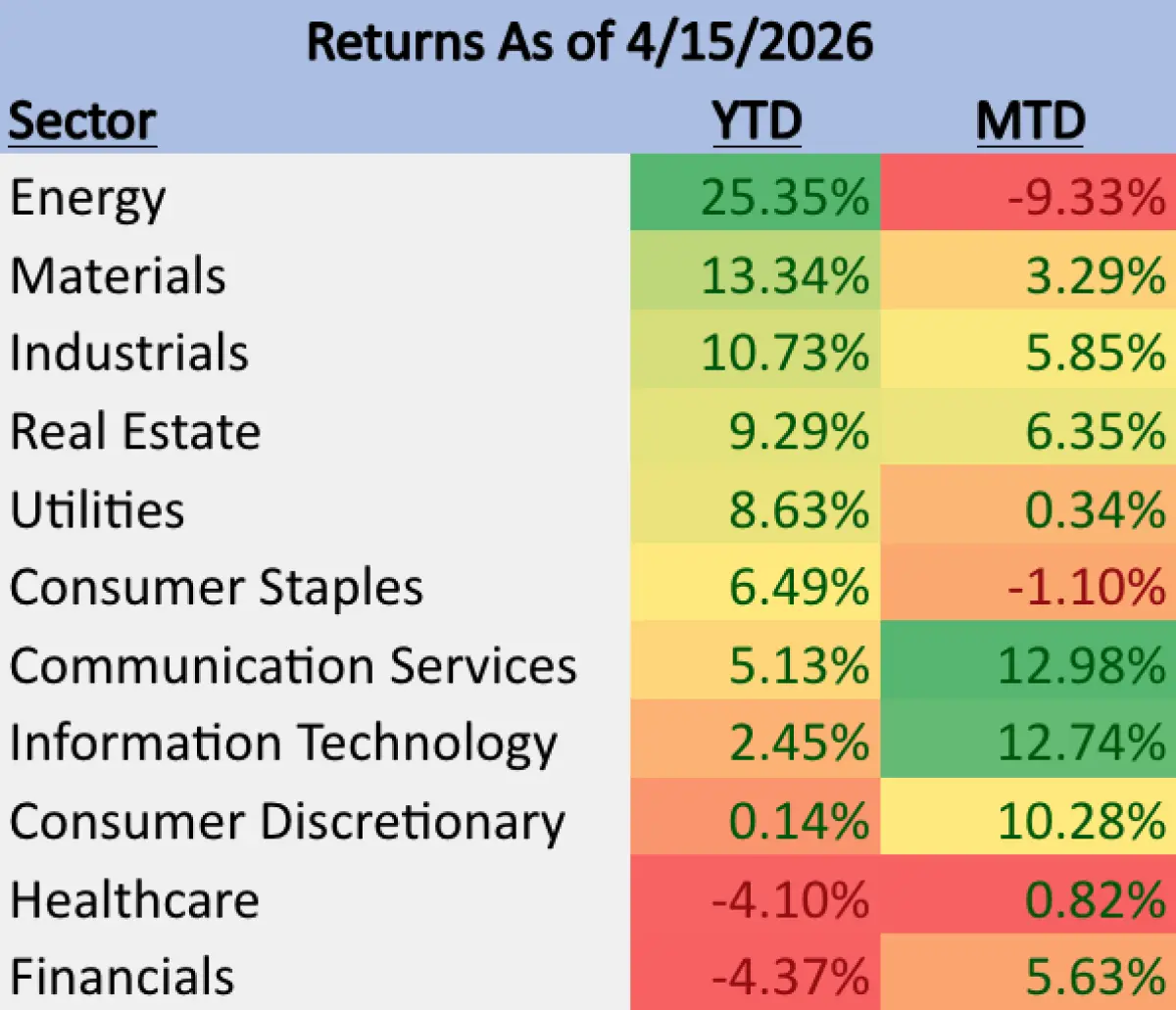
Displaying leadership rallying from the lows, the month-to-date leaders on a sector basis for the US large cap segment have been communications services (~13% MTD), information technology (~12.7% MTD), and consumer discretionary (~10.3% MTD).
While prior to the war with Iran, these sectors had lagged the broader index on a year-to-date basis, that spread has compressed, with communications services now ahead of the S&P 500 on a year-to-date basis at ~5.1%. Similarly reversed, energy continues to lead year-to-date with a stunning ~25.3% return but has seen a significant pullback from those highs in April (~-9.3% MTD).
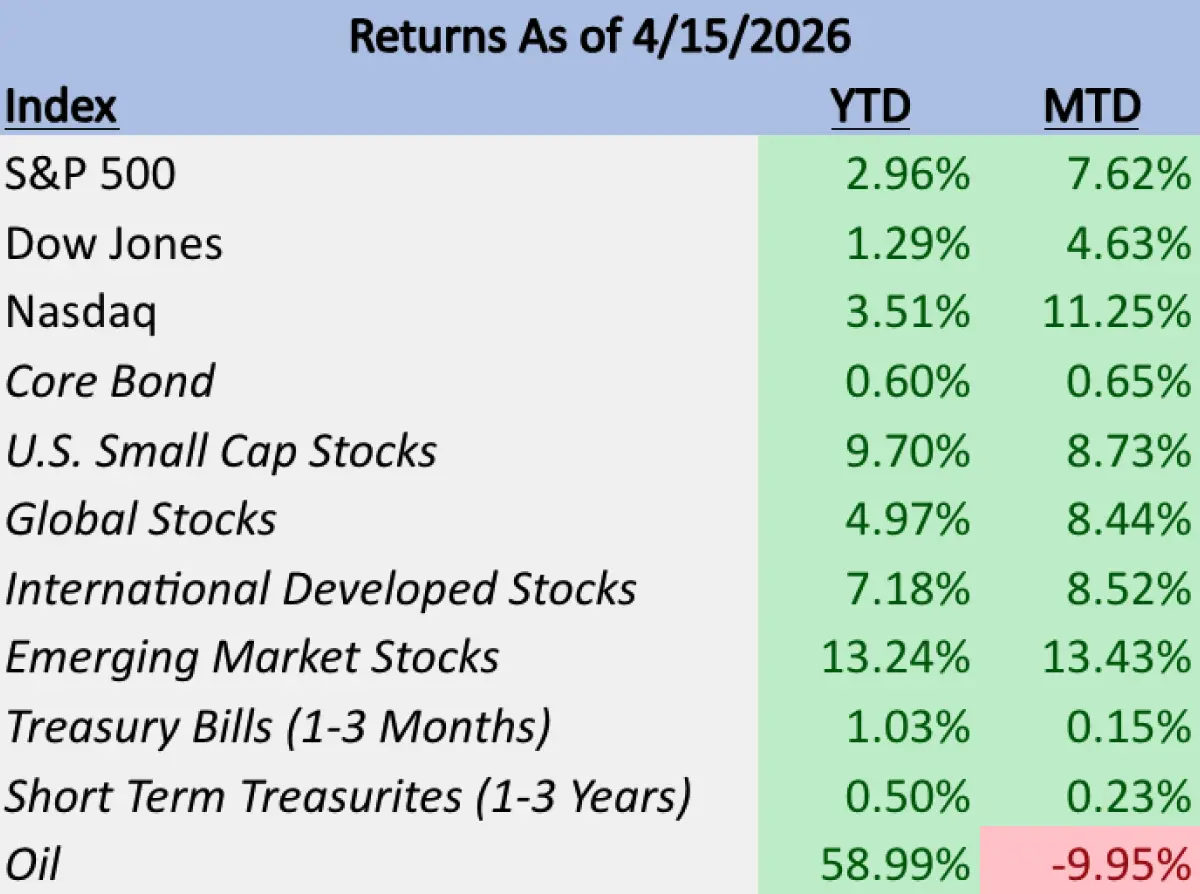
Two trends that remain intact over the course of this year are the leadership from small cap stocks over their large cap counterparts, and relative strength from markets outside of the U.S. The Russell 2000 index (U.S. small cap stocks) has generated a return of 9.7% year-to-date, recovering ~8.7% this month alone, and continuing to lead the S&P 500.
Both international developed (~7.2% YTD) and emerging market (~13.2% YTD) stocks have led the U.S. large cap stock market, and with month-to-date recoveries of ~8.5% and ~13.4% respectively look poised to continue so.
A potential observation that provides a caveat to this dynamic is the resumption in leadership from the mega-cap growth-oriented sectors of communications, tech, and consumer discretionary stocks, along with the fact that the U.S. large cap stock group both held up better on the downside and returned to all-time highs most quickly. As we will discuss further on in this market update, there are some dynamics shaping the U.S. market relative to its global peers that make it more protected from geopolitical/energy price risks.
Further signals of markets finding their footing are declines in US Treasury yields and in the US dollar, signifying a loosening of financial conditions. The 10-year Treasury yield after reaching a monthly high of 4.48% has declined to a range of 4.3%-4.2%. The US dollar, per the DXY dollar index, has fallen below the 100 level back into the high 90’s, a strong indicator of investors’ concerns over geopolitical risk alleviating.
Climbing The Wall of Worry
Despite a variety of sources of anxiety, global equity markets have continued to display what to some has been a surprising level of resiliency. U.S. equity markets in particular, via the S&P 500, are not only above their pre-Iran War levels but are now brushing new all-time highs.
The “Wall of Worry” is a commonly referred to phrase in the world of investing, referring to the observable fact that stock prices tend to rise despite negative geopolitical headlines, economic concerns, and investors’ uncertainties as the source of each concern is alleviated in turn. Bull markets typically last a multiple of 3 to 4 times longer than bear markets, but skepticism is persistent in both.
This present “wall of worry” includes a seemingly fragile ceasefire, fears of an extended oil price shock, the economically disruptive side of A.I. innovation, and potential systemic issues in private credit markets.
History has shown that in either case, bull market continuation or collapse, the reasoning behind the ex-post results will appear abundantly obvious. While we are not in that position of clarity yet, let us take a moment to assess why the current rally in equity markets could continue and speculate as to what may be the source of explanation after the fact.
One reason for optimism is April’s historical position as a strong point of positive market return seasonality. In fact, April has on average produced a 1.6% return with a gain frequency of 68%, the return magnitude ranks April as the second-best month for the S&P 500 on average over the past five decades.
Additionally, the S&P 500 historically has produced higher returns on average after all-time highs than in all other periods. This is true over 1, 3, and 5-year forward periods, and while counterintuitive at first glance, all-time highs are only produced during bull markets, and bull markets tend to go on much longer than investors expect.

Historical S&P 500 Returns after all-time highs – BNY
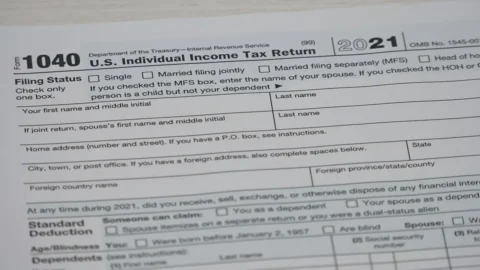
An additional consideration is the culmination of tax season. With the alterations made to the tax code following the passage of the One Big Beautiful Bill Act (OBBBA), many Americans have and continue to be expected to receive higher than prior period tax refunds. These refunds are in essence a form of fiscal stimulus and, hypothetically, a source of further buying power for market participants.
Based off data via the IRS through April 3rd of this year, the average refund is up by ~11% with the average refund tallying $3,462 (up ~$346 from a year ago); the total amount refunded is on track to be up 14.5% from last year with refunds currently totaling $241.74B so far.
The data shared depicted 99.8 million individual returns out of an expected 164 million through the April 15th deadline.
While an average of ~$346 may not seem a lot on its own, the aggregate increase in tax returns represents a substantial, albeit expected to be one-time in nature, source of liquidity. It is necessary to point out that the White House suggested in January that the average taxpayer could receive an increase of more than $1,000 this year due to the OBBBA; the current data, shared earlier, from refunds has not reflected that figure thus far.
The most obvious catalyst of all, is growing optimism that the United States’ war with Iran may be nearing a close, and an agreement may be reached to revive the flow of oil through the Strait of Hormuz.
The last two weeks of headlines around the war have ventured from the U.S. President’s threats to target Iran’s economic infrastructure, an extension and agreement for peace talks, to a U.S. initiated blockade of Iranian ports. Prior to the U.S. blockade’s implementation, American-Iranian peace talks in Islamabad ended without an agreement as Vice President JD Vance, who represented the U.S. during the negotiations, stated that Iran refused to abandon its capacity to pursue a nuclear weapons program.
Meanwhile, the Iranian side claims that the U.S. and Israel “must comply” with a ceasefire that includes Lebanon before any comprehensive lasting peace agreement can be had. Both sides continue to claim the other as violating the terms of the agreement, leading to a ceasefire that has been described as “fragile”. Furthermore, this fragile ceasefire, if no extension is reached, is set to expire in another week.
With all this just described, it would be fair for one to wonder where the optimism comes from. First and foremost, the political signaling from the U.S. and the Strait’s many economic stakeholders (from Middle Eastern countries to Europe and Asia) can mostly be described as explicitly pro-deal.
President Trump has repeatedly stated that the war is “very close to being over”, Turkey recently announced that it was working to extend the ceasefire, and Pakistan (the apparent key mediator) has attempted to arrange a second round of U.S.-Iran peace talks prior to the two-week truce’s expiration, with the U.S. President stating in an interview that the talks could take place “over the next two days”.
At the same time, Lebanese and Israeli officials met in D.C. this week for their first direct diplomatic talks since 1993. Finally, while publicly denied by The White House, there has been unconfirmed movement of the U.S. and Iran being in indirect talks to extend the two-week ceasefire.
Fragile as the ceasefire may be, U.S. equity markets have crossed new milestones as oil markets have found some stability below the $100 crisis threshold. The stock market’s recovery suggests that risks are firmly moving towards de-escalation, meaning either a strengthening ceasefire regime or at least a palatable global economic situation where conflict is less disruptive and contained. Clearly, any lasting ceasefire would likely be preceded by a tenuous one, such as the one had now.
An interesting signal to monitor as the market continues to respond to these ongoing geopolitical developments is where leadership establishes itself.
While the S&P 500 and NASDAQ indices have clawed their way back to a new all-time high, the current year-to-date return leaders in U.S. small cap stocks, along with international developed and emerging market equities, saw steeper drawdowns post-war onset and have yet reclaimed their all-time highs. This could be where the differentiation between a comprehensive end to the war that sees a reopening of the Strait versus a military deescalation, but the ongoing presence of higher geopolitical risk premiums makes a firm impact.
We have described in prior market updates the U.S.’s position as less reliant on oil from the Strait, along with its position as a consumer led economy. With these characteristics comes some inherent resiliency from geopolitical shock. An additional source of consumer spending consistency may be suggested through the change in energy expenditures’ position in the U.S. consumer’s budget.
The following table via the American Petroleum Institute and data from the Bureau of Labor Statistics displays that the share of U.S. consumer disposable income spent on energy costs has fallen from 10% in 1984 to just 5.7% as of 2024. An average this past decade that is the lowest of the four included.

The potential takeaway here is that while the price of energy may reawaken U.S. fears of oil price shocks of the past, the real economic impacts of such price changes are likely subdued compared to the share of costs they once held. This in turn lends a lower degree of volatility in spending power for consumers when compared to energy shocks from geopolitical risk and supply shortages.
If the current ceasefire holds and is extended, with traffic in the Strait of Hormuz at minimum granted some revival, then the market has already demonstrated some willingness to recover with little resistance. If additional fears were alleviated in stagflationary risks with inflationary pressures falling and economic growth reaccelerating, investors’ eyes may turn towards additional market momentum generating catalysts.
Such factors may be an increase in the probability of rate cuts, the evolving A.I. theme, and continued corporate earnings growth. With these developments, it can be assumed that new bricks of worry will be added to the wall for the market to climb.
Early Earnings Season Update
As mentioned among our positive market catalysts, earnings reports for the first fiscal quarter of the year have been rolling in. It is still in the early innings, but among the S&P 500’s constituency, 39 companies have reported their corporate performance for Q1 2026.
Nearly half of the companies to report have come from the financial sector; including banking giants J.P. Morgan, Goldman Sachs, and Morgan Stanley, along with investment management firm BlackRock. On an overall basis, this early sample size has seen the S&P 500 post ~30.9% earnings growth and ~13.2% sales growth, with the average earnings surprise and sales surprise landing at ~10% and ~2.4% respectively.
These early sample numbers are expected to moderate as more companies report (12.6% per Factset), but still maintain pace for the sixth straight quarter of double-digit earnings growth by the index. The earnings calls and commentary so far from reported companies describes continued stability within the consumer driven U.S. economy. On the company’s earnings call, J.P. Morgan CFO, Jeremy Barnum described consumers and small businesses as “remaining resilient, with consumer spend growth continuing above last year’s pace.”
We’ll continue to monitor the developments this earnings season as a more wholistic picture emerges from increased reporting from the different segments of the U.S. economy. For now, it is hard to ignore the strong projections and continued real earnings beats, and the market’s ongoing strength appears to be reflecting that.
A Note on the Economy and The Fed
Economic momentum shifted in late 2025 as real GDP was revised down to 0.5%, trailing the 0.7% forecast. This slowdown was primarily driven by weakened investment and a 43-day government shutdown that stifled public spending. Consumer data also underperformed, with retail sales (0.6% vs. 0.8%) and confidence (91.8 vs. 92.2) both missing consensus. In contrast, the industrial sector has signaled optimism lately with expectation for manufacturing to pick up, evidenced by a fourth month of growth in Industrial Production (0.2%) and a better-than-expected ISM Manufacturing PMI of 52.7.
Furthermore, US consumers, as covered prior, have seen relief in their tax refunds from the OBBBA. According to analysts at J.P. Morgan, if this money were spent over the first 6 months of 2026, it could potentially increase annualized GDP by over 0.5% in the first quarter. While this relief would be temporary in nature, it gives the economy breathing room during a time of turmoil.
March inflation data remains sticky as an energy-driven spike in headline prices contrasted with relatively steady core inflation. Headline CPI rose 0.9% month-over-month, meeting consensus, with a 21.2% surge in gasoline prices serving as the primary driver. This pushed the year-over-year headline rate to 3.3%, a sharp jump from February’s 2.4%.
Meanwhile, Core CPI slightly beat expectations (2.6% vs. 2.7%), and the Fed’s preferred gauge, Core PCE, met forecasts with a 0.4% monthly increase and a 3.0% annual rate. While both PCE and CPI remain higher than the Fed’s desired 2% target, labor market data and the federal reserve’s forecast on interest rates suggest a more positive outlook on reaching that goal.
The U.S. labor market is showing signs that it is reaching supply constraints, as declining immigration tightens the available labor pool. While March saw a significant surge of 178,000 in non-farm payrolls, investors remain cautious, struggling to distinguish genuine expansion from figures that may eventually be revised. Concerns also remain over the future potential ramifications of A.I. adoption on the structure of the labor market.
Following a widely anticipated pause at their March meeting, the target federal funds rate remains at 3.5-3.75%.
Continued concerns over energy market spurred inflation and sentiment extracted from comments by Fed members, continues to see the market pricing out a cut in 2026 as unlikely, with less than half a cut priced into rates over the course of this year. In fact, a full cut isn’t being priced by markets until the summer of 2027, a very different dynamic than presented by interest rate/fixed income markets earlier in the year.
This market pessimism over interest rates contrasts with the dot plot put forth by the Fed at their March meeting, which showed the median FOMC projection of one rate cut in 2026 and another in 2027.
We maintain as our base case that the market is currently overstating the impacts of what is most likely contained inflationary risk driven by a temporary energy spike, and that the nomination of Kevin Warsh as the next chair and risks of a softening job market provide a backdrop for a modest cutting cycle to resume in 2026.
Conclusion
The global stock market has not only continued to climb the “wall of worry” in 2026, but has now seen U.S. large caps capture new all-time highs. Despite a persistent array of risks and a belief that interest rates have reached a period of a long pause, investors continue to display a strong desire for risky assets, and corporate fundamentals have backed them.
While short-term market movements are often driven by headlines and sentiment, including ongoing geopolitical tensions and the uncertainty surrounding upcoming midterm elections, long-term returns remain anchored by fundamentals such as earnings growth, productivity, and disciplined capital allocation.
For investors, this reinforces the importance of maintaining a diversified, risk-aware portfolio aligned with long-term objectives rather than reacting to sporadic episodes of volatility. In our view, staying aligned to an individualized, risk-aware strategic portfolio framework remains the most reliable path for navigating uncertainty while still capturing the market’s long-term wealth-building potential.
Need Some Help?
If you’d like some help from one of our CPAs or CERTIFIED FINANCIAL PLANNER (CFP®) advisors regarding this strategy and how it applies to you, the Rhame & Gorrell Wealth Management team is here to help.
Our experienced Wealth Managers facilitate our entire suite of services including financial planning, investment management, tax optimization, estate planning, and more to our valued clients.
Feel free to contact us at (832) 789-1100, [email protected], or click the button below to schedule your complimentary consultation today.

IMPORTANT DISCLOSURES:
Corporate benefits may change at any point in time. Be sure to consult with human resources and review Summary Plan Description(s) before implementing any strategy discussed herein.Rhame & Gorrell Wealth Management, LLC (“RGWM”) is an SEC registered investment adviser with its principal place of business in the State of Texas. Registration as an investment adviser is not an endorsement by securities regulators and does not imply that RGWM has attained a certain level of skill, training, or ability. This material has been prepared for informational purposes only, and is not intended to provide, and should not be relied on for, tax, legal or accounting advice. You should consult your own CPA or tax professional before engaging in any transaction. The effectiveness of any of the strategies described will depend on your individual situation and should not be construed as personalized investment advice. Past performance may not be indicative of future results and does not guarantee future positive returns.
For additional information about RGWM, including fees and services, send for our Firm Disclosure Brochures as set forth on Form ADV Part 2A and Part 3 by contacting the Firm directly. You can also access our Firm Brochures at www.adviserinfo.sec.gov. Please read the disclosure brochures carefully before you invest or send money.