

Market Update – October 2025
We are midway through October, which marks our passage into the final quarter of what continues to be a strong year for global markets. The beginning of the month saw equity indices rise to new all-time highs, with the S&P 500 breaching the 6700 mark for the first time. However, the last two weeks has reminded investors that risk is never truly absent and that moments of volatility can emerge quickly at any time.
Several risk-driving narratives have emerged in the first two weeks of October. The first: an ongoing government shutdown as a split Senate remains unable to pass funding legislation or extend negotiations. The second, and more immediately impactful risk to markets, has been the re-emergence of trade tensions between the United States and China.
Finally, recent earnings reports and commentary from the financial sector have brought questions as to the health of private credit markets. As markets continue to digest these conditions, results for third quarter corporate earnings and a Federal Reserve interest rate decision loom on the horizon.
Market Summary
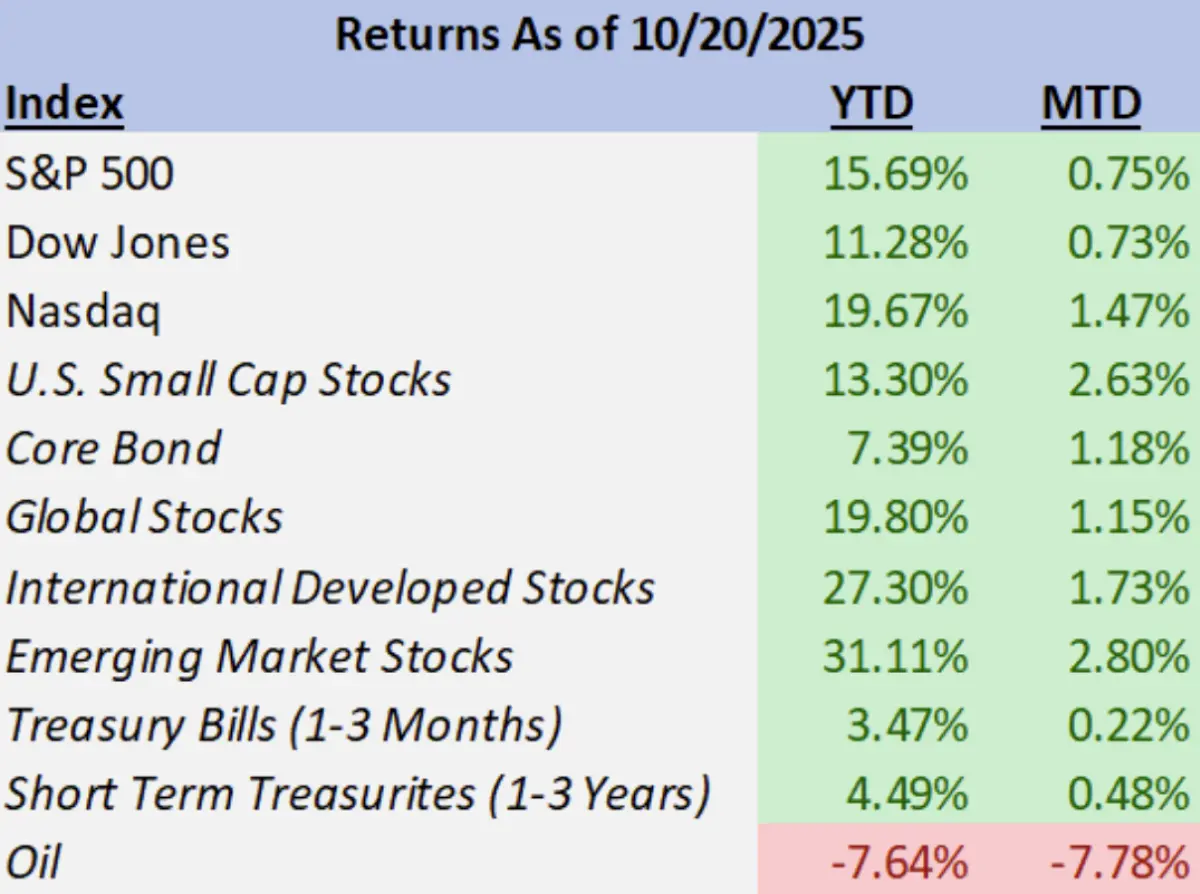
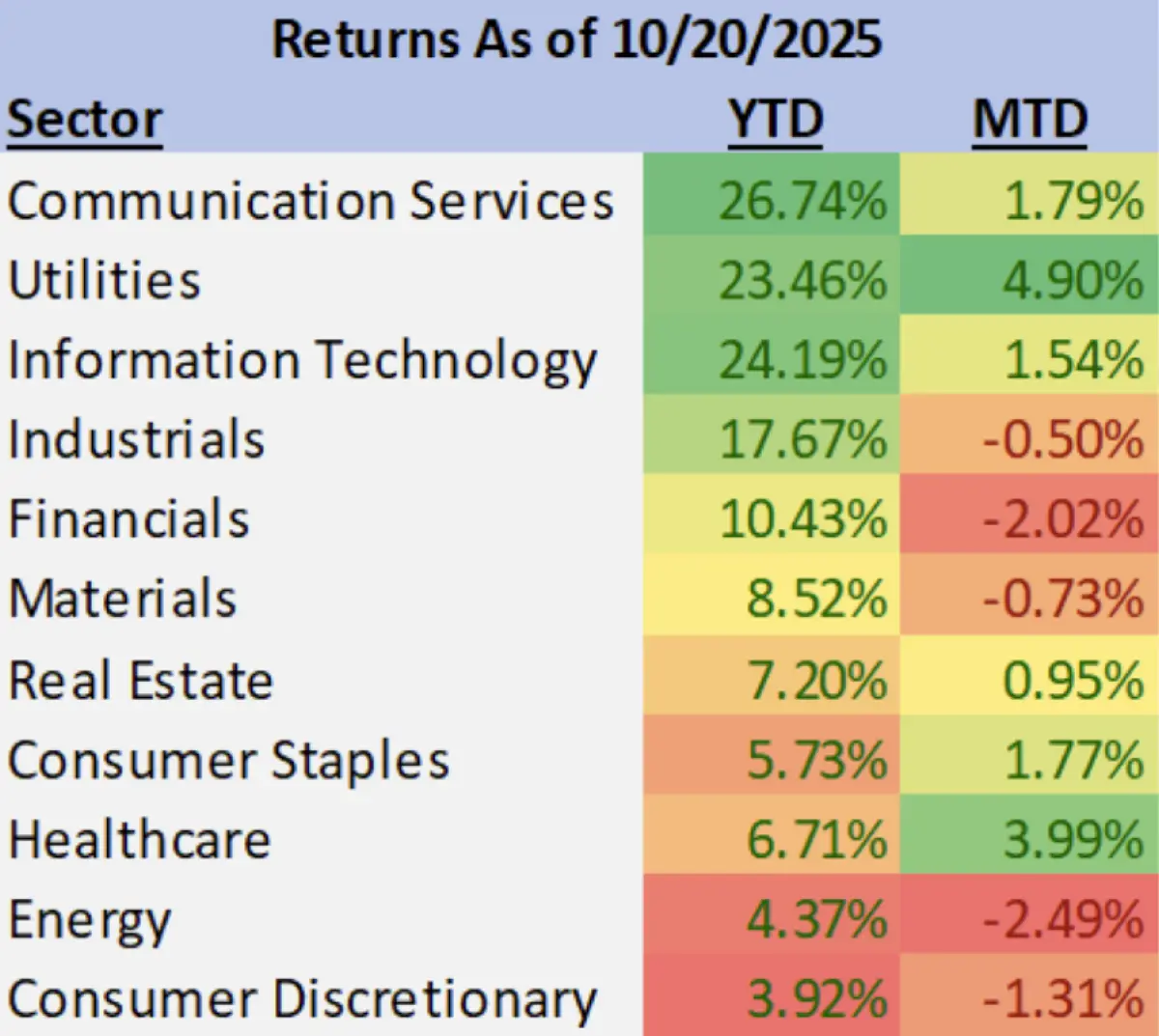
Equity markets broadly remain within range of recently established all-time highs. The S&P 500 has produced a strong year-to-date return of ~15.7%, propelled by a combination of sectors ranging from cyclical, growth, to defensive.
Communications services (~26.7% YTD), utilities (~23.5% YTD), and technology (~24.2% YTD) continue to lead the broader market, while industrials (~17.7% YTD) have also provided outperformance. The biggest laggards have been the energy (~4.4% YTD) and consumer discretionary (~3.9% YTD) sectors.
U.S. small cap stocks remain underperformers relative to their large cap counterparts but have significantly closed the gap over the second half of the year with returns sitting at ~13.3% year-to-date. Meanwhile, foreign equities both from developed and emerging markets have provided investors with diversifying outperformance.
Emerging market stocks in particular have resumed a strong rally since September, returning ~10.2% since that month’s start. With a year-to-date return of ~31.1%, emerging markets have now outgained their developed markets counterparts (~27.3% YTD).
However, both foreign equity segments remain large laggards to the U.S. over longer time horizons. This signals the question as to whether this performance gap will continue to converge or if a resumption in the longer-term modern trend of American equity outperformance will ensue. Attractive relative valuations and continued dollar weakening are potential supportive tailwinds for foreign equities over the near-term.
Bond markets have continued to rally following cooling labor data, stabilizing inflation, and the Federal Reserve’s resumption of the cutting cycle. The Bloomberg Aggregate Bond Index has rallied in October, bringing the year-to-date return for the bond market to ~7.4%. With the central bank largely expected to continue cutting over the year’s remaining meetings, a continuation of improving inflation related data will be a key catalyst as to whether the bond rally can continue.
Tariff Policy Update
The start of October saw markets reach new all-time highs, with the S&P 500 closing the end of October 9th, on track for nearly another percent on the month. The next day, the U.S. equity index began the day in the green before dramatically reversing downward following comments from the President threatening to place a “massive increase of Tariffs” on Chinese products imported into the United States.
The resulting aftermath of the announcement saw the S&P 500 close down -2.7% on the day and the VIX “volatility” index rise to its highest level since June. The index has since clawed back most of those losses (up ~2.8% since Friday) but remains slightly below its high.
In the days following the initial surprise statement from the President, there have been additional details provided, but much of the uncertainty remains. The initial catalyst for the rise in tensions erupted due to a recent announcement from China regarding sweeping capital control restrictions on rare earth exports. Chinese dominance of the global supply chain for rare earth minerals has been a hot political topic with important ramifications in both economic and national defense security.
According to the International Energy Agency, China controls 60% of the mining and more than 90% of worldwide refining of rare earth minerals. Furthermore, the U.S. Geological Survey reports that the U.S. is dependent on China for around 70% of its rare earth imports.
Technology, ranging from the renewable energy space (wind turbines, electric vehicles, solar panels) and batteries to national defense (such as the F-35 fighter jet) utilize rare earth materials as key components.
China’s policy announcement was essentially a ban of rare earth material exports for use by foreign militaries. The restrictions come in advance of planned upcoming trade talks between Chinese and U.S. political leaders.
As part of its more detailed response, the U.S. administration proclaimed a new 100% tariff on Chinese goods as a possibility starting on November 1st, or earlier, depending on the nation’s next actions. The President later stated in a social media post that the administration was considering an embargo of Chinese cooking oils; to put the impact in perspective, the U.S. accounted for 43% of total used cooking oil exports in 2024. The U.S. has also voiced frustration and concern over Chinese purchases of Russian oil.
This last weekend, however, saw some attempts at cooling the temperature of the dialogue between the two countries, as plans for multiple upcoming meetings between the nations’ diplomats edge closer. The U.S. President stated in an interview on Sunday that the current tariff rates totaling as much as 157% on Chinese imports are “not sustainable,” but and suggested that compromises would need to be made for these rates to come down. Trump is set to meet with Chinese President Xi Jinping in South Korea at the end of this month.
A potential wildcard that could be overhanging these negotiations, and the power of the President’s frequent use of tariff threats as leverage in global trade discussions, lies with the Supreme Court. The nation’s highest judicial authority is set to hear the Trump administration’s appeal of a lower federal court ruling that the broad use of tariffs under the International Emergency Economic Powers Act (IEEPA) were not lawfully enacted.
The Supreme Court agreed to fast track the appeal after the lower court’s initial ruling in August. At the center of the issue is whether the executive branch has the constitutional authority to impose or maintain broad tariffs—such as those enacted during the previous administration under Section 232 of the IEEPA—without direct congressional approval.
These tariffs, originally justified as national security measures, now account for roughly $70 to $100 billion in annual import duties and affect a wide range of goods from steel and aluminum to consumer electronics. The Court’s ruling will determine whether the president can continue to wield such unilateral power over trade policy or whether that authority must return to Congress, a decision that will define how future administrations manage economic competition with China and other trading partners.
The potential ramifications are significant for both the economy and financial markets. A ruling that upholds the executive’s authority could preserve the current framework of trade barriers, keeping upward pressure on input costs, inflation, and corporate margins for companies reliant on foreign materials or components.
Conversely, a decision that limits or reverses the tariffs could unwind years of trade friction, lower import costs, and create tailwinds for manufacturers and consumers alike—though it may also introduce fiscal challenges if tariff refunds are mandated. Treasury Secretary Scott Bessent stated that the U.S.
Treasury Department would have to issue refunds for “about half the tariffs”. As of the close of fiscal year 2025 in September, the U.S. budget deficit declined slightly to $1.78 trillion, down from $1.82 trillion in 2024 as tariffs accounted for a net $195 billion in revenue.
Beyond the direct impact on prices and profits, this case represents a broader shift in how the U.S. balances political power, economic strategy, and global competitiveness. Regardless of the Court’s decision, investors will be weighing the pros and cons of tariffs’ benefit as a national revenue source and the headwinds they’ve created in higher costs for globally supplied private sector companies.
Government Shutdowns and The Markets
At the same time as investors have been dissecting these issues, the federal government has now entered its fourth week of a shutdown. After failing to secure a 2026 budget funding deal or a continuing-resolution to fund the government until further negotiations could be had, the government has been shutdown since October 1st.
At its core, the dispute comes from House Republicans seeking deeper spending cuts and recissions against Senate Democrats demanding maintenance of health-care subsidies and Medicaid protections. Roughly 900,000 federal workers now face furloughs while another 700,000 remain working without pay. Federal agencies have suspended or degraded many services, with U.S. economic data collection (or lack thereof) coming into the spotlight as an obvious symptom of the shutdown’s impact.
Data used by economic and financial decision makers has been broadly impacted. Reports ranging from labor (nonfarm payrolls and initial jobless claims), inflation (CPI), to consumption (retail sales) have been put on hold indefinitely or delayed (CPI will be released 10/24) due to the shutdown’s impact on staffing for these agencies. The impact of the shutdown is also expected to be felt by the overall economy, as Oxford Economics estimates a reduction to GDP growth of 0.1-0.2% per week of the shutdown’s continuation.
Historically speaking, government shutdowns have had muted effects on financial markets. Investors have demonstrated a willingness to look through the noise of short-term disruptions and placed a greater emphasis on longer-term economic trends. As the following table from First Trust shows, short-term S&P 500 returns from the start of government shutdowns have historically been positive on average.

Economic and Federal Reserve Update
While the government shutdown has delayed the release of many indicators analysts rely on in assessing the trajectory and state of the U.S. economy, there are still data points available for observation. Purchasing managers’ indices for the September period showed positive reads for the services sector and mixed reporting for manufacturing.
The S&P Global US reported positive expansion level results (value > 50) for all of the Composite, Services, and Manufacturing PMIs. The ISM PMI values showed expansion leaning results for services while manufacturing was slightly contractionary at 49.1 but higher than the prior period’s 48.7. The Atlanta Fed’s GDPNow model continues to forecast strong economic growth for the third quarter, with the latest estimate reading 3.9%.
The data available for inflation is fairly limited due to the shutdown, with US CPI having its release delayed to October 24th. This release will hold particular importance as it arrives just a few days before the Federal Reserve’s interest rate decision on October 29th.
While the government’s inflation centric data remains on hold, market indicators have moved in a constructive manner in recent weeks as it pertains to inflation. US breakeven yields, which are the spreads between U.S. Treasury bonds and inflation-protected Treasuries (TIPS) of the same maturity, have moved lower in October. Short-term market pricing for inflation (via the 2-year breakeven yield) has edged lower by ~0.15% over the course of this month, while longer-term inflation expectations priced by the 30-year breakeven yield has fallen a more modest ~0.04%.
An alternative inflation measure known as Truflation—which tries to show the rough equivalent of US CPI in real-time—indicates inflation to be running at a rate of ~2.27% year-over-year. This number remains stubbornly above the 2% target for the Federal Reserve but has seen substantial progress from the YTD highs.

Year-Over-Year Truflation Rate (October 2024-October 2025)- Bloomberg
Even without many of the relevant data points that are often parsed over leading up to its announcements, the market is largely expecting the Federal Reserve to continue the rate cutting cycle at its next meeting. Futures markets are now almost fully pricing in an interest rate cut at the October meeting, and furthermore, these markets are also now pricing an additional cut at the year’s final meeting on December 10th.
A cut in October would bring the Fed’s target federal funds rate down to a range of 3.75-4.0%, with another cut in December bringing the rate to 3.5-3.75%.
While risks certainly remain to the market’s thesis given the recent shutdown-produced data vacuum, continued signs of softening in the job market provide support for the Fed proceeding in its more dovish stance. The most recent ADP employment change number for September showed a major miss in expectations of 32K jobs lost versus expected growth of 52K.
Earnings Season and the Financial Sector
Corporate earnings for the third quarter have begun to report, and while the releases have been limited to just 58 companies in the S&P 500, the results have thus far been positive. With this small sample, sales growth has tracked at 7.94% (with a 1.67% positive surprise) and earnings growth has paced nearly 16% (5.75% positive surprise).
26 of the companies having reported come from the financial sector, with the big banks following their typical schedule of being among the first large firms to release earnings. Major U.S. banks delivered a strong third quarter: investment-banking fees, trading revenues and net interest income all came in ahead of expectations, highlighting resiliency in consumer spending and corporate activity. In aggregate, the financial sector surprised sales and earnings to the upside of 2.9% and 7.35% respectively, with earnings growth on track for 21.62%.
In addition to being the early headline of earnings season, the financial sector has also been in the news for less inspiring reasons as concerns regarding the health of the “shadow banking” system have come back to the surface. Two recent bankruptcies have been the impetus for this recent rise in concern over private credit and the potential for contagion it could produce in the financial system.
Tricolor Holdings, a Dallas-based sub-prime auto lender and used-car dealer, filed for Chapter 7 bankruptcy in September 2025, citing assets and liabilities in the range of $1 billion to $10 billion. The firm specialized in very high-risk auto loans to consumers with little or no credit history, and its downfall has been tied to alleged fraudulent activity and weak underwriting.
Meanwhile, First Brands Group, an Ohio-based automotive-parts conglomerate that grew rapidly via debt-fueled acquisitions, filed for bankruptcy in late September 2025 with more than $10 billion in liabilities and serious accounting and off-balance-sheet financing irregularities — including reports of roughly $2.3 billion in receivables that “simply vanished”. Several high-profile lenders and private credit funds reported to have significant exposure to the company.
Together, these cases highlight potential stress in the “shadow-lending” or private-credit markets. JPMorgan CEO, Jamie Dimon, recently warned in an allegorical statement: “when you see one cockroach, there are probably more.”
To this point, the private credit space has continued to grow and is expected to double in size by 2030 (according to BlackRock). It still, however, represents a relatively small slice of the overall credit-lending universe, with the US investment-grade bond market and bank loan markets sitting at a much higher $9 trillion and $11 trillion level respectively.
In addition to the relatively smaller proportion of the credit market, private credit has also historically produced only a modestly higher default rate (between 2.4% and 5.2%) compared to high yield bonds (1.5%) and leveraged loans (1.86%).
The Federal Reserve noted this in two recent assessments of the asset class in the last year, reporting that although financial stability implications of the asset class is limited, they “exhibit lower default probabilities” overall than many non-bank lenders. They importantly provided additional context to the lack of economic pressures the asset class has historically had to withstand with the additional note that “the industry has yet to go through a prolonged recession.”
Overall, we see these recent developments as a cautionary tale that reinforces the need for ongoing and thorough due diligence for any investment opportunity. These markets warrant continued monitoring and the potential for crossover effects to the banking system is likely a legitimate risk, but the size of the market still represents a modest portion of the overall financial system and the regulatory apparatus governing the public lending environment remains stronger and more robust than in previous economic cycles.
Conclusion
As we enter the final stretch of the year, the backdrop continues to be one that rewards market participation, but with a watchful eye for risk management. Markets have shown remarkable resilience through a mix of political and economic uncertainty, and despite bouts of volatility driven by trade tensions and fiscal gridlock, the broader trend of earnings growth, moderating inflation, and economic stability remains intact. Corporate fundamentals continue to support admittedly high valuations, and the Federal Reserve appears positioned to maintain a gradual easing path.
While challenges such as tariff uncertainty, questions over the health of lending market segments, and the ongoing government shutdown present near-term risks, they also serve as reminders of the value of diversification, discipline, and long-term perspective.
In our view, the current environment favors continued participation within a strategic risk balancing framework. We will continue to diligently assess the economic and market factors and adjust our positions to best fit this dynamic environment.
Need Some Help?
If you’d like some help from one of our CPAs or CERTIFIED FINANCIAL PLANNER (CFP®) advisors regarding this strategy and how it applies to you, the Rhame & Gorrell Wealth Management team is here to help.
Our experienced Wealth Managers facilitate our entire suite of services including financial planning, investment management, tax optimization, estate planning, and more to our valued clients.
Feel free to contact us at (832) 789-1100, [email protected], or click the button below to schedule your complimentary consultation today.

IMPORTANT DISCLOSURES:
Corporate benefits may change at any point in time. Be sure to consult with human resources and review Summary Plan Description(s) before implementing any strategy discussed herein.Rhame & Gorrell Wealth Management, LLC (“RGWM”) is an SEC registered investment adviser with its principal place of business in the State of Texas. Registration as an investment adviser is not an endorsement by securities regulators and does not imply that RGWM has attained a certain level of skill, training, or ability. This material has been prepared for informational purposes only, and is not intended to provide, and should not be relied on for, tax, legal or accounting advice. You should consult your own CPA or tax professional before engaging in any transaction. The effectiveness of any of the strategies described will depend on your individual situation and should not be construed as personalized investment advice. Past performance may not be indicative of future results and does not guarantee future positive returns.
For additional information about RGWM, including fees and services, send for our Firm Disclosure Brochures as set forth on Form ADV Part 2A and Part 3 by contacting the Firm directly. You can also access our Firm Brochures at www.adviserinfo.sec.gov. Please read the disclosure brochures carefully before you invest or send money.