
Market Update – May 2026
2026 has been a year defined by sharp contrast. The first quarter confronted investors with a confluence of serious headwinds. Energy markets rose and geopolitical tensions elevated following the United States’ military action in Iran. The domestic labor market displayed signs of weakness through a combination of poor early year jobs reports and even more concerning downward revisions.
Finally, there was growing apprehension about artificial intelligence’s potential to disrupt the software industry, which sent shockwaves through software related equities and the private credit funds orbiting them. The cumulative weight of these developments pushed the S&P 500 to a first quarter decline of -4.35%.
The second quarter has delivered a decisive reversal. Since the end of March, the S&P 500 has recovered approximately 14%, bringing the year-to-date return to roughly 9%.
Two forces have been central to this turnaround. First, investors have increasingly priced in a belief that the closure of the Strait of Hormuz will be resolved before causing lasting damage to the broader economy. Second, and perhaps more consequentially, a firm conviction has taken hold around the transformative and long-term earnings potential of artificial intelligence.
That conviction has been buoyed by an impressive corporate earnings season with the S&P 500 reporting first quarter earnings growth of approximately 27.5%, surpassing consensus expectations by roughly 16.3%. If this trend continues for the remainder of companies awaiting their earnings reports, this would represent the strongest quarter of earnings growth since Q4 2021. Sales growth has been equally impressive, with the index reporting revenue expansion of approximately 11.1% in the period.
The sections that follow provide a closer look at the dynamics driving these results, including sector-level market performance, a detailed review of earnings across the index, and an update on the economic landscape, including the Federal Reserve’s evolving leadership and the latest readings on inflation, employment, and growth.
Market Summary
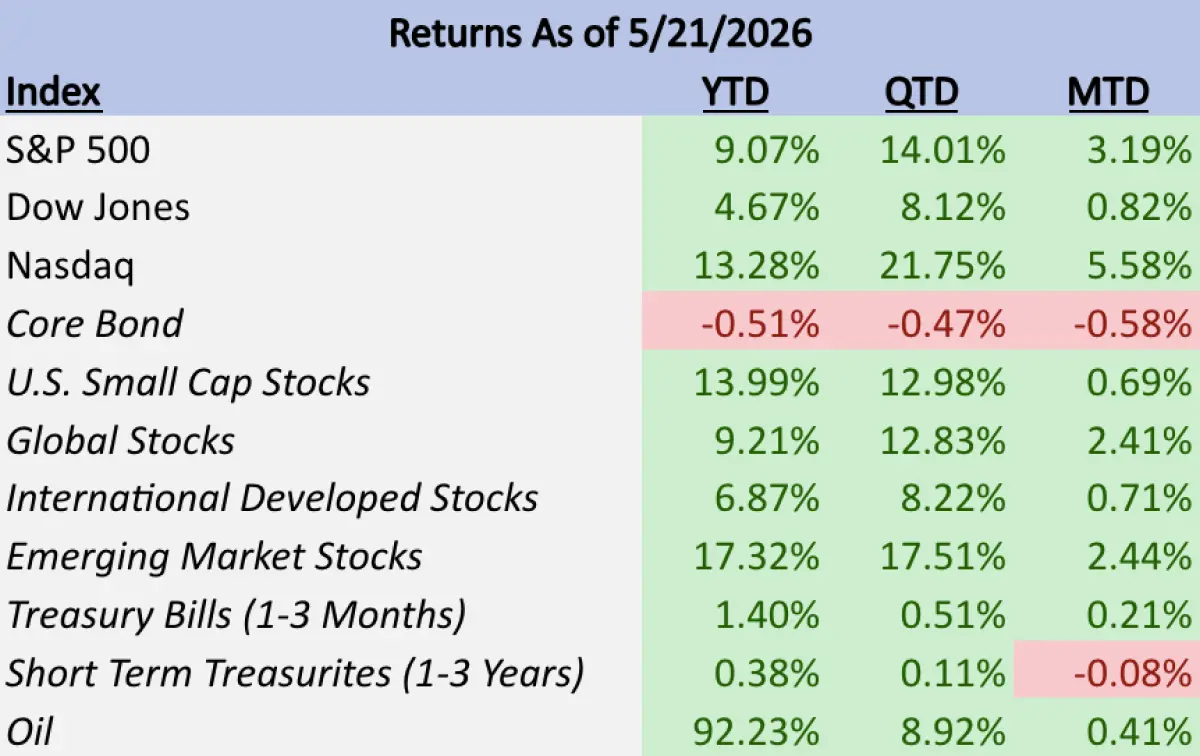
While strong earnings results have driven overall market performance in the second quarter, a notable shift in market breadth and leadership has occurred relative to what investors observed earlier in the year. As recently as late February, the prevailing narrative centered on a “broadening out,” with international developed markets, small-cap equities, and sectors outside of technology and communication services meaningfully outpacing the S&P 500.
On February 27th, International Developed Equities (MSCI EAFE) had returned approximately 10% on the year, compared to roughly 0.70% for the S&P 500. Since that date, the dynamic has sharply reversed, with the S&P 500 gaining approximately 8.3%, while the MSCI EAFE has declined roughly 2.9%.
This reversal reflects how quickly and decisively the investment landscape can shift. The Strait of Hormuz closure introduced a new layer of economic uncertainty that disproportionately pressured non-U.S. markets, while the surge in artificial intelligence-driven earnings growth reignited investor appetite for large-cap U.S. technology and growth-oriented equities. The result has been a meaningful re-concentration of market leadership in the sectors and geographies best positioned to benefit from those two themes.
The experience also reinforces the value of maintaining a geographically diversified portfolio. Different market environments tend to favor different regions, and the relative strength demonstrated by international equities in the first part of the year served as a reminder that concentration in any single market can introduce meaningful risk.
The one notable exception to the recent reversal has been emerging markets, which have continued to advance in both regimes. Their relative valuation discount to U.S. equities, combined with significant exposure to artificial intelligence-adjacent industries such as semiconductors, has helped support performance across changing conditions.
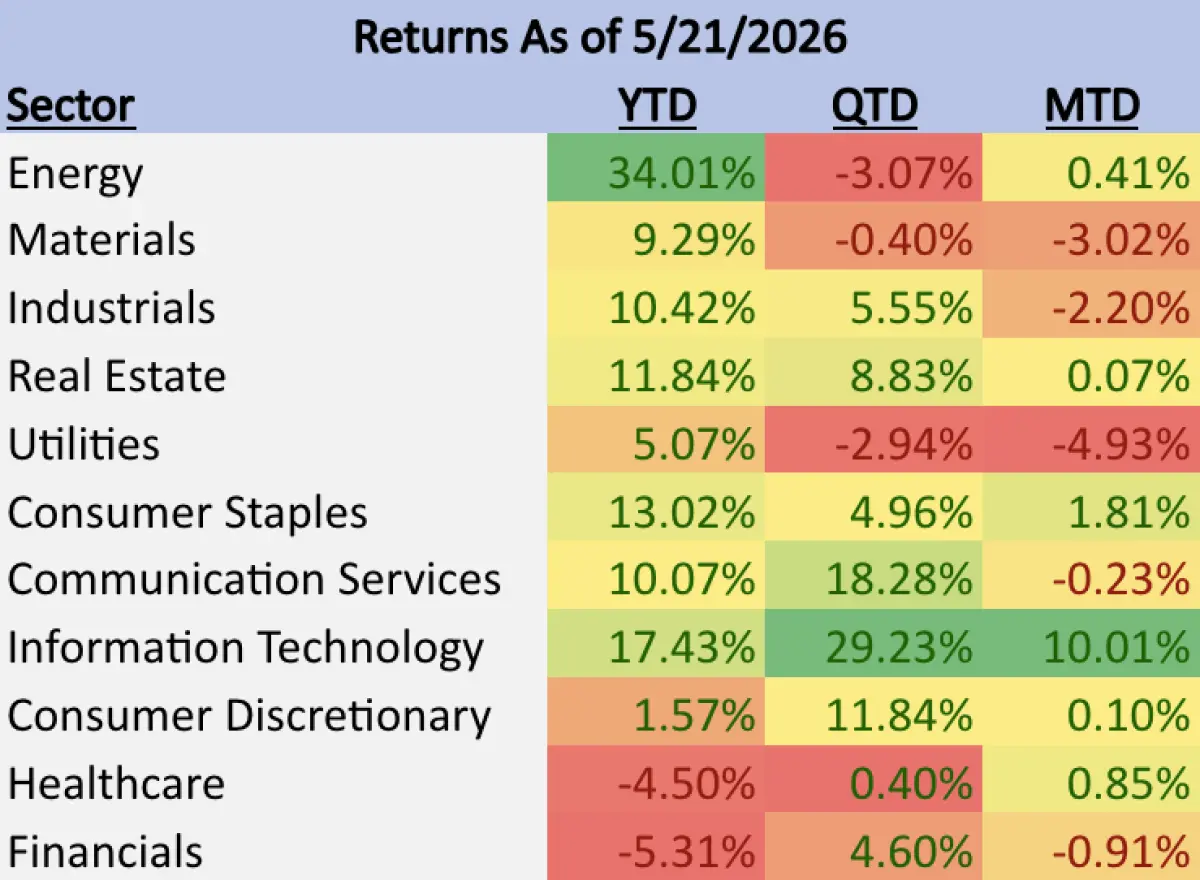
At the sector level, technology has led all groups quarter to date with a gain of approximately 29.2%, followed by communication services, which has returned roughly 18.3% and continues to meaningfully outpace the broader index.
On a month-to-date basis, technology remains the only sector currently exceeding the S&P 500’s return, with a gain of approximately 10%. Looking at the full year-to-date picture, energy stands out as the top-performing sector with a return of approximately 34%, though it has given back some ground on a quarter-to-date basis, pulling back roughly 3% as energy supply uncertainty has been partially priced into the market.
While equity markets have recovered meaningfully in the second quarter, the government bond market has continued to reflect ongoing uncertainty. Since the end of March, the yield on the 10-Year U.S. Treasury has risen from approximately 3.9% to roughly 4.6%, reaching levels not seen since the spring of 2025.
The move higher in yields reflects a combination of factors, including persistent inflation concerns tied to the Strait of Hormuz disruption and evolving expectations around Federal Reserve policy under new leadership. For investors holding fixed income, this rise in rates has produced modest price headwinds, though elevated yields also represent improved income potential for new allocations into the asset class.
Earnings
First quarter earnings results for the S&P 500 have come in well ahead of expectations across virtually every dimension. The results reflect broad-based top-line strength alongside the more widely discussed profitability gains. Against consensus estimates, earnings per share beat expectations by roughly 16.3%, a margin of outperformance that underscores the degree to which analysts underestimated corporate resilience heading into the quarter.


S&P 500 Sales and Earnings Data- As of 5/21/2026 (Bloomberg)
Technology delivered the strongest overall performance among all sectors, posting sales growth of approximately 29% and earnings growth of approximately 50.2%, both comfortably ahead of analyst expectations. The results affirm the investment thesis that artificial intelligence is not only a long-term growth story, but is already translating into measurable near-term profitability for the sector’s leading companies.
The most significant positive surprises relative to expectations came from the communication services and consumer discretionary sectors. Communication services reported earnings growth of approximately 46.9%, surpassing estimates by roughly 51%. Consumer discretionary companies grew earnings by approximately 41%, representing a similar degree of upside versus consensus. These sectors benefited from a combination of resilient consumer spending, strong advertising demand, and improving operating leverage.
Healthcare was the lone sector to report negative earnings growth during the quarter, declining approximately 3.1% year over year. However, even this result came in ahead of analyst expectations, suggesting that the sector’s challenges were already well understood and reflected in forecasts. As the earnings season concludes, the overall picture is one of broad corporate strength, with the weight of evidence supporting continued confidence in the fundamental backdrop for U.S. equities.
Economic Update
A labor market that appeared weak in the first quarter, has shown signs of strengthening over the last two months. April nonfarm payrolls for April (reported earlier this month) saw the 115K jobs added over the month beating analyst expectations and also saw an upward revision to the previous month’s number to 185K jobs in March. Unemployment remained unchanged at 4.3%.
On the economic growth front, the end of April saw the advanced estimate for first quarter’s GDP. Growth came in below estimates at 2% relative to the 2.3% expected in the consensus estimate.
Inflation fears, weakness in housing, and geopolitical uncertainty all likely weighed on consumer spending in addition to a drag from a negative net trade contribution. Optimistically, there are signs that a bounce back in growth for the second quarter could be on the horizon.
The Atlanta Fed’s GDPNow model estimates a jump in real GDP to a 4.3% rate as of the latest estimate. This is largely attributed to an expected increase in real personal consumption expenditures, as well as an increase in real gross private domestic investment.
Headline CPI came in at 3.8% YoY, the highest in 3 years and an increase from the March 3.3% reading, while core CPI came in at 2.8%, an increase from last month’s 2.6%. PPI came in at 6% YoY, the largest annual increase since December of 2022.
According to the Bureau of Labor Statistics, the largest contributor to CPI Inflation has been from transportation (coming in at 7.1% YoY). While markets have largely been anticipating a shortage of energy, investors are starting to see the real supply of energy in the economy shrink, likely contributing to the higher inflation seen over the last month.
According to the International Energy Agency, the oil supply has plummeted by 10.1 mb/d to 97 mb/d in March, with continued restrictions to tanker movements in the Strait of Hormuz, leading to the largest disruption in history. As the risk of inflation becomes more and more evident, investors seek to understand how the new Fed Chair will act to balance this data with unemployment.
The dynamic of potential stabilization in the labor market tightness, reacceleration of economic growth, and already higher than desired supply shortage induced inflation presents a difficult to maneuver backdrop for incoming new Fed Chair, Kevin Warsh.
The Federal Reserve likely sees a resurgence in inflation as the primary risk of their dual mandate. While his term as Fed Chair has concluded, Powell will remain on the Fed’s Board of Governors as his term as governor does not lapse until January of 2028, leaving him in a unique position of sitting in the same room as his successor.
The senate confirmed Warsh to be the next Fed Chair Wednesday May 13th in the most divisive vote in history (54-45 in favor). The current administration has been very transparent about the desire and expectation for Warsh to start cutting interest rates, which will be a challenging mandate considering the recent inflation data that has been reported, and the potential to exacerbate the inflationary moves that have been seen.
We continue to believe that the structure of the Fed as a democratic voting body will continue to provide ample insulation from political pressure, and that they will remain data driven in their decision making.
Until recently, the case for whether to cut interest rates or leave them be had effective arguments on both sides; with individual conclusions likely being determined as to whether one believes the oil price supply driven factors could be looked through as temporary.
However, the Strait of Hormuz remains closed, and with the recent stabilization of the job market and potential for reaccelerating economic growth, rate cuts are now considered exceedingly unlikely, with rates expected to be unchanged for the year and the probability of the next move being a hike by early next year being priced in by Fed Funds futures markets.

Fed Funds Futures Market Implied Overnight Rate & Number of Cuts/Hikes (Bloomberg)
Conclusion
As we move deeper into the second quarter, the fundamental backdrop for U.S. equities remains constructive, supported by an earnings season that has exceeded even the most optimistic expectations. That said, the road ahead is not without complexity or risk.
Inflation pressures tied to the Strait of Hormuz disruption, a Federal Reserve navigating a politically charged transition, and a bond market pricing in a higher-for-longer rate environment all warrant careful attention. Additional political risk could emerge as US midterm elections approach.
We remain focused on maintaining well-diversified portfolios that are positioned to participate in continued growth while managing exposure to the risks that the current environment presents. As always, we will continue to monitor developments closely and communicate with you transparently as the landscape evolves. We are grateful for the trust you place in us and remain committed to helping you navigate these markets with clarity and confidence.
Need Some Help?
If you’d like some help from one of our CPAs or CERTIFIED FINANCIAL PLANNER (CFP®) advisors regarding this strategy and how it applies to you, the Rhame & Gorrell Wealth Management team is here to help.
Our experienced Wealth Managers facilitate our entire suite of services including financial planning, investment management, tax optimization, estate planning, and more to our valued clients.
Feel free to contact us at (832) 789-1100, [email protected], or click the button below to schedule your complimentary consultation today.


IMPORTANT DISCLOSURES:
Corporate benefits may change at any point in time. Be sure to consult with human resources and review Summary Plan Description(s) before implementing any strategy discussed herein.Rhame & Gorrell Wealth Management, LLC (“RGWM”) is an SEC registered investment adviser with its principal place of business in the State of Texas. Registration as an investment adviser is not an endorsement by securities regulators and does not imply that RGWM has attained a certain level of skill, training, or ability. This material has been prepared for informational purposes only, and is not intended to provide, and should not be relied on for, tax, legal or accounting advice. You should consult your own CPA or tax professional before engaging in any transaction. The effectiveness of any of the strategies described will depend on your individual situation and should not be construed as personalized investment advice. Past performance may not be indicative of future results and does not guarantee future positive returns.
For additional information about RGWM, including fees and services, send for our Firm Disclosure Brochures as set forth on Form ADV Part 2A and Part 3 by contacting the Firm directly. You can also access our Firm Brochures at www.adviserinfo.sec.gov. Please read the disclosure brochures carefully before you invest or send money.