

Market Update – August 2025
Equity markets remain substantially positive on the year as we enter the second half of August. These stock market gains have demonstrated both resiliency and a continued investor appetite for risk despite recent cracks emerging in the economic backdrop.
The first half of the month saw a series of poor economic data points in both the labor market (change in nonfarm payrolls) and inflation (Core CPI and PPI), bringing into question both the ongoing health of the U.S. economy and the trajectory of the Federal Reserve’s interest rate policy.
Perhaps helping to buoy the stock market, however, has been a solid corporate earnings season (Q2 2025) that has outperformed analyst expectations and has the S&P 500 on track for its third consecutive quarter of double-digit earnings growth. Amid these fundamental dynamics is recent momentum in prospective peace talks between Ukraine and Russia that could potentially see de-escalation in the nearly three and a half year long war. These important market driving narratives and more will be further discussed below.
Market Summary

Global equity markets have continued their march higher year-to-date. Large cap U.S. stocks (per the S&P 500) have returned 9.64% since the start of the year, having more than recouped their losses since the post-Liberation Day tariff selloff.
Growth stocks (Russell 1000 Growth) have led their value counterparts (Russell 1000 Value) to this point of the year. After having lagged value from the beginning of the year through the tariff downturn, growth stocks have bounced back (rising over 37% since the bottom compared to just over 19% for value) and now sit at ~9.6% on a year-to-date basis compared to ~8% for value.

Sector-related performance reflects this trend year-to-date, although not all value sectors have trailed. For 2025, communications services (15.28%) and technology (13.03%) have led the way for growth, but value sectors in industrials (15.53%) and utilities (15.48%) have led the overall S&P 500.
All sectors have been at least modestly positive, with the consumer discretionary (0.07%) and healthcare (0.9%) sectors essentially being flat on the year.
While the overall stock market has seen sizable gains for the year, there have been other examples of noticeable dispersion, particularly when examining market cap and region.
On the negative side, small cap U.S. stocks (Russell 2000) remain laggards on the year, having returned just ~2.6%. It is worth noting that small caps have more than kept up with large cap stocks since the April 8th low (both the S&P 500 and Russell 2000 have returned ~29% from that point), but with small caps having seen a sharper Liberation Day drawdown and trailing performance in the leadup, this stock segment remains well behind the broader market.
When looking overseas, foreign stocks (MSCI ACWI ex US) have outperformed domestic equities year-to-date (~22%). Both developed markets (MSCI EAFE) and emerging markets (MSCI EM) have participated in the gains with returns of ~24% and ~19% respectively.
While having stabilized and rallied since its July low, the US Dollar Index has seen the dollar depreciate ~11% from its January high. This weakening of the dollar has been a strong tailwind for foreign equities.
Since hitting a high watermark of ~4.8% in January, the 10-year Treasury yield has moderated to ~4.3%. This has been of benefit to the U.S. bond market (Barclays US Aggregate) which has gained ~4.6% on the year. Outside of the very front and the far back of the curve, Treasury yields have fallen variably (in degrees of significance) since the end of 2024. For example, 3-year Treasuries have fallen nearly 60 bps (0.60%) on the year.

10-Year Treasury Yield and Spread (8/20/2025 relative to 12/31/2024)- Bloomberg
Credit spreads (US Corporate BAA 10 Year Spread), while higher than where they were at the year’s start, have also rallied from their year-to-date highs in April. In tandem with this decline in yields and spreads has been a commiserate decline in bond market volatility.
The MOVE Index, which tracks a basket of options and U.S. interest rate swaps to measure U.S. bond market volatility, has declined to levels near its lowest point since January 2022. This current decline in bond market volatility is of welcome relief to investors looking for a defensive ballast to their overall portfolios.
An additional sign of this return to diversification benefits can be seen when examining the correlation between stocks and bonds over the past year compared to the poor market environment seen in 2022. From March 2022 to October 2023 the correlation between the S&P 500 and Barclays US Agg indices was 0.237; that correlation has fallen to 0.089 over the past year.
Pushing this rally in bonds has been the market’s perception of a rate cut in September being increasingly likely. Fed Funds Futures markets are currently pricing an ~85% chance of an interest rate cut from the U.S. central bank in the September 17th meeting.
Earnings Update
With nearly 93% of S&P 500 membership having released their earnings results for the second quarter, the results have been largely a positive surprise in both sales (an average beat of 2.22%) and earnings (an average beat of 8.2%). At this point, the S&P 500 is on track for sales growth of ~5.9% and earnings growth of ~11.2%.
This would mark the index’s third consecutive quarter of double-digit growth in EPS. When taking into context that investor consensus expectation was for the quarter’s year-over-year EPS growth to be 5.6% (the weakest growth since Q4 2023), one can see how this outperformance of expectations could be a fundamental catalyst for the market’s continued resiliency.
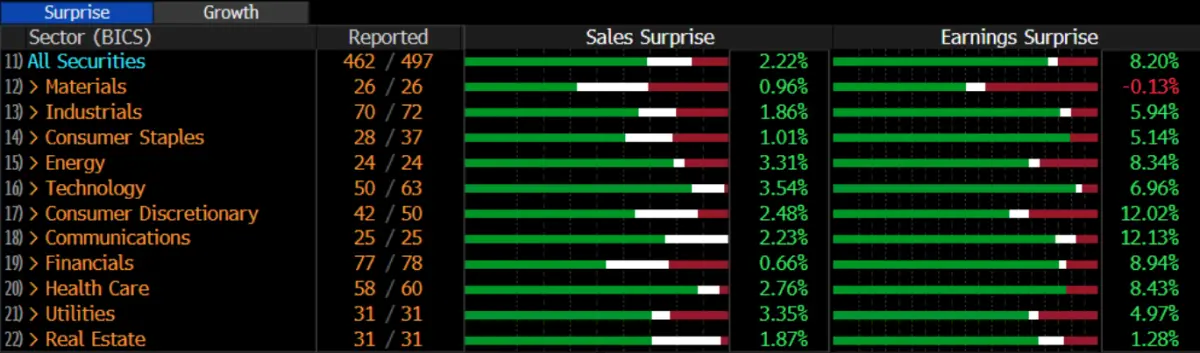

Q2 2025 Sales and Earnings Growth for S&P 500 Sectors (8/19/2025)- Bloomberg
From an absolute performance standpoint, the largest growers of shareholder wealth have come from the communications services sector. Assisted by strong earnings from Meta Platforms (META, ~38%), Alphabet (GOOGL, ~22%), Uber (UBER, ~34%), and Doordash (DASH, 132.4%), this sector grew earnings by ~55% in aggregate. Despite already having expectations for robust earnings growth, communications services outperformed analyst forecasts to the tune of ~12%.
From a growth standpoint, technology (~16%) and financials (~16%) also had strong quarters. Helping the overall index’s better than expected quarter were results from the consumer discretionary sector which beat estimates by 12%, producing overall EPS growth of 2.7% averting an expected decline. Largely contributing to the positive quarter was Amazon (AMZN), which radically outperformed expectations by ~27% and grew earnings ~35%.
While the results from earnings have been largely positive and well received by investors, management guidance and commentary on the economic environment provides additional nuance to the current market environment. On the pessimistic side, corporate executives from Home Depot and Walmart described an environment not without its challenges.
Home Depot’s CFO, Richard McPhail, told Bloomberg that the company is “seeing larger projects remain on hold as rates remain elevated and economic uncertainty persists.” This points to the hurdle that higher interest rates create on expensive projects such as large home renovations and remodeling projects.
Walmart’s CEO, Doug McMillon, pointed to the company’s observation that “American consumers are showing signs of stress as food prices remain stubbornly high.” The executive’s statement reiterates that the inflationary pressures continue to especially harm lower and middle-income consumers. Caterpillar provided additional perspective on the current impacts of tariff policy, with confirmation that tariff costs amounted to $250M-$350M in headwinds for Q2 which was the upper end of their estimates.
The economic headwinds may be felt by both consumers and cyclical economic sectors, but one area that has not seen much sign of slowing has been the spending of mega cap technology companies on AI related investments.
Alphabet’s CEO, Sundar Pichai, stated that “AI is positively impacting every part of Google’s business”, and boosted its capital spending target to $85 billion as the company aims to expand data centers. Meta Platforms, via its CFO commentary, echoed similar sentiments, as the company anticipates its 2025 expenses to rise 20-25% to $114-118 billion driven by continued investment in AI development and infrastructure.
Economic Update
The end of July saw the advanced release of GDP for the second quarter, and the results (at 3% year-over-year growth on the quarter) were an even higher than anticipated bounce back from a first quarter that saw a decline of -0.5%. What was a well-publicized drag from import hoarding in Q1 was a boost in the advanced estimate for Q2. In contribution terms, the impact was a ~5% contribution in Q2 versus a -4.6% detraction in Q1. These larger-than-usual impacts are represented by the orange bars in the chart below.

Contributions to US GDP QoQ% (Q4 2020-Q2 2025)- Bloomberg
Some concern in these numbers can be gleaned from a continued moderation in consumption compared to the strength displayed throughout 2024. While higher than in Q1 and still firmly in positive territory, the sub 1% contribution from personal consumption expenditure leaves little room for further deceleration if economic growth is to continue a healthy expansion.
Future quarters are less likely to receive the same boost from net exports that the second quarter’s reversion provided. The end of August will see the second estimate of Q2 GDP and plenty of attention will be paid to any notable revisions to the growth metric.
Investors will have to wait until the end of October for the advanced estimate of Q3 GDP. Just over midway through the third quarter, the Atlanta Fed’s GDPNow model is estimating this quarter’s economic growth to be tracking at a rate of 2.3%. This rate of growth would be significantly higher than the current consensus economists’ estimate of 1.3%.
Retail sales data for July, an increase of 0.5% on the month, were slightly below estimates of 0.6% and point to consumption having moderated somewhat since a resurgent 0.9% jump in June. More concerning is that retail sales ex auto and gas decelerated to 0.2% from the 0.8% month-over-month increase in June.
Forward looking indicators such as Purchasing Managers Indices (PMI) also paint a mixed growth picture. Both the ISM and S&P Global PMI data reflect a manufacturing sector that contracted in July. On the services side, both the ISM and S&P Global PMIs showed services to be in marginal expansion for the month.
On the inflation front, the data revealed pricing pressures remain stubbornly above the Fed’s target of 2%. In the consumer metrics, headline CPI once again rose 2.7% year-over-year in July, while the month-over-month saw a modest deceleration to 0.2% (compared to 0.3% in June). The month-over-month figure was in line with economists’ estimates while the year-over-year number was slightly lower.
On the negative side, core CPI (ex food and energy) was above analyst estimates in year-over-year terms at 3.1% (3% est) and an acceleration from 2.9% in June. The monthly core number saw an acceleration in line with estimates at 0.3% versus 0.2% the month prior.
While this data was overall perceived as worse than expected, the producer related inflation data was the more concerning report. Core PPI (ex food and energy) saw a rise of 0.9% for July compared to 0.2% expected, and a sizable acceleration from being unchanged in June. This put the year-over-year producer inflation metric at 3.3% compared to 2.4% the month before. While marginal accelerations could be seen throughout all contributing categories, the surge in PPI could be most attributed to finished consumer services and trade of finished goods. Making up those categories were margins for machinery and equipment wholesaling, which spiked 3.8%, and trade in capital equipment for both the private and government purchased segments. This appears to be a piece of evidence suggesting that the pricing pressures from tariff policy are making their way downstream as opposed to businesses having absorbed them in prior months.
As it pertains to the labor market, the July 2025 report revealed some noticeable deterioration, with only 73,000 jobs added for the month, well below expectations of 105,000. More striking were substantial downward revisions for the prior two months: May’s gains were revised from +144,000 to +19,000, and June’s from +147,000 to +14,000—a combined reduction of 258,000 jobs.
This revised data suggests that job growth has virtually stalled since April, pushing the threemonth moving average of job gains to its lowest nonpandemic level since the 2010s. The unemployment rate edged up slightly to 4.2%, and job gains were especially weak in sectors like federal government, construction, health care, and hospitality.
Taking all these developments together, it places the Federal Reserve in a challenging position as their policy decision in September must balance the softening of the labor market with evidence of hotter than desired inflation. In our point of view, the balance of risks point to a rate cut at the next meeting.

Implied Trajectory of Federal Reserve Interest Rate Policy (as of 8/20/2025)- Bloomberg
The market, per the implications of interest rate futures markets mentioned earlier, continues to lean this way as well. Due to no meeting scheduled for August, another round of inflation and labor market data will be available prior to the September FOMC decision. While the jobs report may stabilize and provide a picture of a firmer labor market than the recent data suggested, an inflation report with less severe price acceleration would likely be the key metric for investors to monitor in the week prior to the meeting.
Despite the latest reports’ gloomier ramifications, they still represent a small subsection of a longer-run economic backdrop of both labor market tightness and inflation that is well off prior highs. The current dynamics point toward a Federal Reserve that will likely lean into a more dovish posture that we believe will ultimately provide more favorable economic conditions going forward.
Geopolitics
In a potential positive development, recent high-level diplomacy between the White House, Russian, Ukrainian, and European leaders suggests the most promising evidence yet of momentum towards a potential ceasefire or peace framework for the Russia-Ukraine war.
The conflict since its beginning in early 2022 has resulted in a staggering loss of life with total casualties of killed and wounded nearing 1.4 million per the Center for Strategic and International Studies. The cost to Ukrainian infrastructure had surpassed the equivalent of $176 billion as of the end of February per the World Bank, and estimates for the total cost of reconstruction and recovery of the country being north of $500 billion.
Given the ongoing nature of the war and general distance in desires for both sides, the prospect of a ceasefire or near-term peace agreement should certainly be noted with a high degree of uncertainty. The recent week of meetings saw a summit between President Trump and Russian President Vladamir Putin in Alaska, followed by the White House hosting Ukrainian President Zelenskyy alongside key European Leaders. Some key takeaways included Putin agreeing for the first time that NATO-style security guarantees for Ukraine could be on the table (albeit not officially joining NATO).
Security guarantees in some form have been firmly called for by European leaders, but the degree to which the U.S. wishes to align with them remains uncertain. Overall descriptions of the White House meeting suggest that it was constructive, with the next potential step being a trilateral summit between Zelensky, Putin, and the U.S. President.
From an economic and market perspective, a peace deal or ceasefire would be the alleviation of a key risk that has continued to loom in the backdrop. European markets rallied following the recent developments. A de-escalation of conflict could provide relief to the energy and commodity related producers and continue to boost sentiment in these markets. The path forward towards peace is far from certain, but the recent momentum provides more hope than was previously anticipated.
Conclusion
In sum, markets continue to balance strong earnings and improving bond market stability against a backdrop of softer economic data and lingering inflationary pressures. The resilience of corporate profits, particularly from growth and technology sectors, has helped offset concerns raised by slowing payroll growth and elevated producer prices. Investors also take some encouragement from moderating Treasury yields, tighter credit spreads, and the return of diversification benefits between stocks and bonds.
On the global stage, the possibility of progress in Russia–Ukraine peace talks offers a constructive sign, even if outcomes remain uncertain. Attention going forward will be heavily focused on new economic data and how this impacts the likelihood of the Federal Reserve reducing interest rates at the September meeting.
Together, these factors suggest that while risks remain elevated, the foundation for cautious optimism is intact. For investors, maintaining diversification, staying selective within equities, and keeping a disciplined approach to risk should allow portfolios to participate in potential upside while managing volatility.
Need Some Help?
If you’d like some help from one of our CPAs or CERTIFIED FINANCIAL PLANNER (CFP®) advisors regarding this strategy and how it applies to you, the Rhame & Gorrell Wealth Management team is here to help.
Our experienced Wealth Managers facilitate our entire suite of services including financial planning, investment management, tax optimization, estate planning, and more to our valued clients.
Feel free to contact us at (832) 789-1100, [email protected], or click the button below to schedule your complimentary consultation today.

IMPORTANT DISCLOSURES:
Corporate benefits may change at any point in time. Be sure to consult with human resources and review Summary Plan Description(s) before implementing any strategy discussed herein.Rhame & Gorrell Wealth Management, LLC (“RGWM”) is an SEC registered investment adviser with its principal place of business in the State of Texas. Registration as an investment adviser is not an endorsement by securities regulators and does not imply that RGWM has attained a certain level of skill, training, or ability. This material has been prepared for informational purposes only, and is not intended to provide, and should not be relied on for, tax, legal or accounting advice. You should consult your own CPA or tax professional before engaging in any transaction. The effectiveness of any of the strategies described will depend on your individual situation and should not be construed as personalized investment advice. Past performance may not be indicative of future results and does not guarantee future positive returns.
For additional information about RGWM, including fees and services, send for our Firm Disclosure Brochures as set forth on Form ADV Part 2A and Part 3 by contacting the Firm directly. You can also access our Firm Brochures at www.adviserinfo.sec.gov. Please read the disclosure brochures carefully before you invest or send money.