
Market Update – December 2025
November proved to be an eventful month for the stock market. While the end of the month saw little aggregate change for the S&P 500 (up 0.25%), the movement to this essentially muted return was quite notable. The lows for the month saw the large cap stock benchmark decline more than 5% from its highs and the VIX volatility index close at its highest level since the April “Liberation Day” tariff turmoil.
This bout of market volatility appears to have been brief. Since November’s volatility and stock market pullback respectively peaked and bottomed, many market segments have either mostly recouped their losses or even reached new all-time highs. As an often seasonally positive part of the year approaches for markets, several of the factors that instigated the resultant recent volatility remain overhead.
While the government shutdown has ended, the Federal Reserve cut rates at its December meeting (as broadly anticipated), and the fog of the economic data drought is clearing. Risks remain in the form of the forward trajectory of the Federal Reserve’s interest rate policies, the results from the resumption in economic data reporting, and an apparent increase in investor desire for supportive evidence of A.I. driven earnings impacts.
Market Summary

Stocks have resumed an upward climb since their temporary setback earlier in the fall. The S&P 500 is near all-time highs and has notched an ~18.5% return year-to-date, led by substantial sector gains in communication services (~33.9%) and technology (~27.5%).
The industrial sector has also seen significant above benchmark gains (~19.6%), while the biggest laggards on the year have been consumer staples (~3.7%) and real estate (~2.7%). While still trailing the broader market year-to-date, healthcare has surged in the final quarter of the year, rallying nearly ~9.3%.

While small caps continue to trail their large cap counterparts this year, the Russell 2000 has seen a sizable catch-up in the fourth quarter. Small caps have returned nearly ~5.3% since the start of October and have risen ~2.4% this month alone, beating the S&P 500 over those periods. Confirmation of further easing monetary policy from the Federal Reserve and alleviation of growth concerns have been headwinds as we enter another seasonally positive period for the market segment.
International developed and emerging market equities continue to persist in their leadership over stocks in the U.S. Their respective indices, the MSCI EAFE and MSCI Emerging Markets Index, have returned sizable gains. On a quarterly basis, the tide has shifted towards domestic equities’ favor as the U.S. dollar has seen mild strengthening following substantial year-to-date weakening.
Bonds have participated in the year’s rally as well, with the Bloomberg Aggregate Bond Index returning ~7% year-to-date. The yield curve for government bonds has seen steepening over the course of the year, with short-term and intermediate-term yields falling alongside the Fed’s interest rate cuts, but longer-term yields rising as the growth outlook has stabilized and inflation concerns persist.

U.S. Treasury Yield Curve (1M-30Y Maturities) at 1D, 3M, and 1Y Lookback- Bloomberg
Investment grade credit spreads, while off their 2024 lows, remain at levels reflective of a healthy economy with low risk of defaults. The temporary rise in volatility exhibited in stock markets during November did not translate to substantially higher spreads in the corporate credit markets.

IG Credit Spreads (US Corporate BAA 10Y)- Bloomberg (December 2024-25)
Federal Reserve and Economic Update
On Wednesday, the Federal Reserve announced their largely expected decision to reduce the benchmark interest rate with another quarter-point cut. While concerns had risen in the fall that perhaps the Fed would be reticent of further loosening monetary policy due to the lack of economic data from the government shutdown, the central bank ultimately leaned toward the weakening labor market side of their dual mandate in the decision.
The move to cut interest rates was not a unanimous decision, as the vote ultimately split 9 to 3. Among the dissents were two members favoring a pause and another supportive of a steeper 0.50% cut.
Fed Chair Jerome Powell signaled that the new level of the federal funds rate placed the central bank and economy in a comfortable position to respond to the resumption of economic data that will arrive before the January meeting. An important observation can be seen from his assessment that the Fed perceives the new level of interest rates as in the range they would consider “neutral”, meaning neither stimulative nor contractive to the economy.
Powell stated, “we’re in the high end of the range of neutral” and furthermore that “we haven’t made any decision about January”. He then reiterated that “we’re well positioned to wait and see how the economy performs.”
The recent decision marked the third consecutive cut from the FOMC. The federal funds rate has fallen 1.75% from its peak in September of 2024.
Given the Fed’s longer run growth (1.8%) and inflation (2%) expectations, the current rate of 3.5%-3.75% lies firmly in this neutral range. The risk to the markets comes from the need for the upcoming economic data in the near-term to provide evidence that the current policy path is conducive to market expectations.
Following the latest Fed announcement, interest rate futures markets are effectively pricing 2.2 cuts in 2026. The Federal Reserve’s own latest released “Dot Plot” of the interest rate path shows the median projection as just a single cut expected in 2026, along with a wide dispersion with four governors seeing rates on hold, three seeing a hike, and eight seeing multiple cuts.
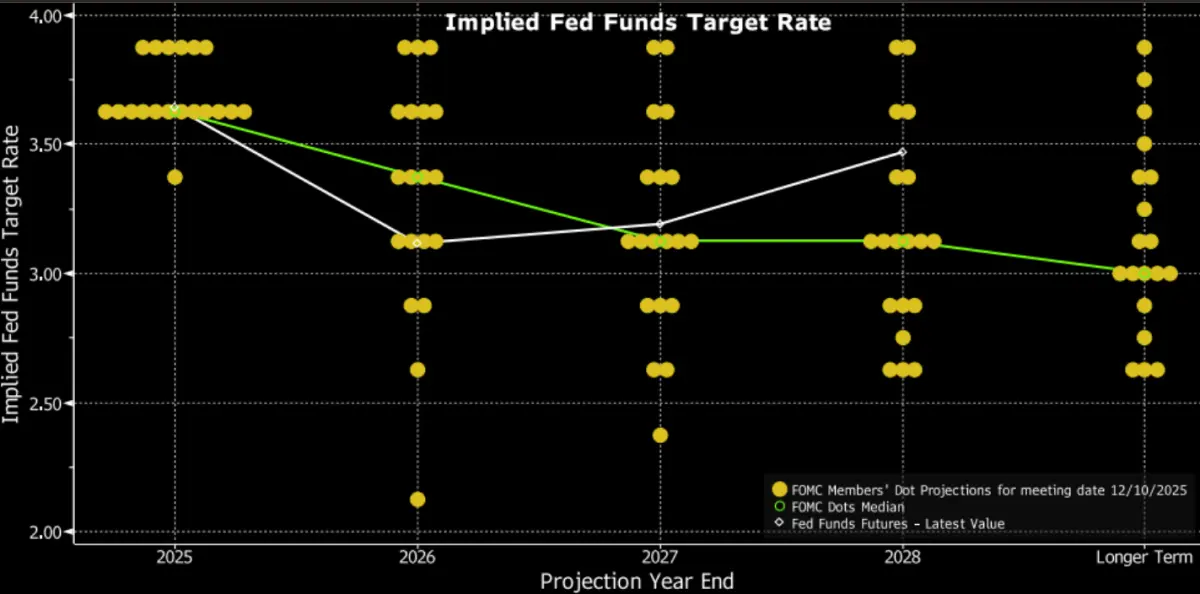
December FOMC Interest Rate Projections Dot Plot- Bloomberg
A single cut difference in expectations (between markets and the median dot plot) is not a radical difference, but given the variation in FOMC opinion, it is very likely that the economic data will drive a clearer consensus in the weeks ahead. The last data for inflation seen was for the September period, with both CPI (3%) and the Fed’s preferred measure, core PCE (2.8%), remaining in a stubborn range above the 2% target rate.
The next two weeks will bring Core PCE data for October and CPI data for November, so the current inflationary fog market participants have been navigating in will be lifted. While not a perfectly comparable barometer, the private sector gauge of real-time CPI data known as “Truflation” has not moved significantly from where it was in September.

Year-Over-Year Truflation Rate (December 2024-December 2025)- Bloomberg
Perhaps further supportive of a continued downward trajectory of interest rates from here was Powell’s comments on the cause and nature of the current inflation overshoot. Powell stated that “it’s really tariffs that are causing most of the inflation overshoot” and that his expectation on their impact is likely to be a “one-time price increase.”
Balanced alongside the inflation trajectory question are the variables of growth and the labor market. The Atlanta Fed’s GDPNow model is currently estimating real GDP growth of 3.5% for the third quarter of 2025. This real-time model estimate is higher than the current consensus economist forecasts of 3.2%.
Meanwhile, labor market assessments have largely been driven by private sector surveys for the last month, with government facilitated payroll and unemployment reports unreleased for October. ADP employment change data showed a positive upside increase of 42k jobs in October but a downside miss of -32k jobs lost in November. Quit and layoff rates indicated by the JOLTS job reports for October and November were fairly muted in those periods. The federally managed payroll and unemployment reports will return next week, providing important job market data for the November period.
Overall, our view remains in line with that of the Federal Reserve: that tariff impacts on the inflation rate are likely short-term in nature, economic growth should remain positive, and the labor market, while having softened, remains in a healthy state. Our belief is that the trajectory of interest rates are more likely to be marginally lower from here with the bar for increasing rates being high and unlikely.
Earnings and AI
As the third quarter earnings season comes to a close, the takeaway could be seen as another overall positive quarter with a few notable exceptions. With 495 of the 500 companies in the S&P 500 having reported, the index is tracking for sales and earnings growth of ~8.3% and ~12.9% respectively.
Both of these performance figures surprised to the upside of analyst expectations. Sales have surprised to the upside by ~2% and earnings beat estimates by ~6.3%.
The results mark the fourth consecutive quarter of double-digit earnings growth for the index. While 83% of companies reported a positive earnings surprise, investors responded less favorably than typically observed with smaller price gains for earnings beats and more severe punishments for misses.
It could be theorized that higher investor expectations raised the bar for rewarding company performance this last season. The technology and financial sectors led the way in earnings growth at ~27% and ~24% respectively, while healthcare and consumer discretionary stocks both led in the surprise category with ~11.9% and ~11.6% beats each.
Another interesting (albeit unsurprising) note from this earnings season was a continued rise in S&P 500 companies commenting on AI during earnings conference calls. According to FactSet, the term “AI” was cited on 306 earnings calls conducted by S&P 500 companies during the earnings period.
This was not only well above the 5-year average of 136 and 10-year average of 86; it was the highest number of citations over the past 10 years overall. 95% of companies from the technology and communications services sectors cited the term “AI” on their calls.
Of course, among the largest operators within the AI theme are the mega cap companies making up the “Magnificent 7”. These companies (including Nvidia, Amazon, Apple, Microsoft, Alphabet, Meta, and Tesla) in aggregate posted strong growth in earnings (16.8%) and sales (~18%).
However, it is important to note that both the aggregate positive surprise in those figures compared to analyst estimate narrowed, and the dispersion of performance in those metrics among each company varied significantly. Collectively, the Mag 7 saw upside surprise of just ~2.2% in sales and ~1.7% in earnings, with the earnings performance trailing that of the broader S&P 500.
The most recent quarter would be just the third time in the last nine quarter that the Mag 7 trailed the S&P 500 in earnings growth surprise percentage. At more than ~4.5% below the S&P 500’s earnings estimate beat, this quarter is set to be the most the Mag 7 has trailed over that period.

Mag 7 vs S&P 500 EPS Surprise % (Q1 2023 – Q3 2025)- Bloomberg
Among the members of the group, Alphabet, Amazon, and Microsoft saw the most significant earnings beats at ~26.6%, ~25.3%, and ~12.3% respectively. Meta trailed expectations in earnings significantly due to a massive non-recurring tax charge, but continues to show strong ad growth and healthy profitability when adjusting for this expected to be one-time in nature tax expense.
A primary potential takeaway for these companies, and the many others outside of the Mag 7 collective, is the rising need to both showcase sustainability of capital expenditures on A.I infrastructure and provide near-term tangible results of their impacts on growth and profitability.
In a market with currently high valuations, these are the signs that can continue to support seemingly expensive multiples while real revenue and earnings grow to meet them. Furthermore, a broadening out of earnings performance within the market can also be a healthy driver of broadening returns that does not necessarily result in poor performance from the mega cap segment.
December and the “Santa Claus Rally”
As a closing note of optimism for investors as we approach the end of the final month of 2025, December has historically been a strong month for stocks. December has been both an upper half returning month on average for the S&P 500, and the month with the highest historical positive win rates. The data below shows the average returns by calendar month from 1990 to 2024, as well as their positive return “hit rates”.

S&P 500 Calendar Month Returns and Positivity Rates (1990-2024)- Data from YCharts
Over the 35 Decembers from 1990 to 2024, 27 of those were positive returning months for the market with an average return of ~1.44%. The return for December ranks 5th among months for average market returns while the 77% hit rate is tied with November for the highest monthly percentage of positive moves.
Included in this data are the 2025 monthly return numbers. The monthly returns indicate that while apparent seasonal patterns may be viewed over the data’s timeframe, a single year can widely vary from that trend in any given observation. For instance, while September has both the lowest average monthly return and the lowest positive “hit rate” (essentially a coinflip), this year saw September produce the third highest return among the first 11 months.
Within December also exists what has been coined the “Santa Claus rally”. First coined by the 1972 Stock Trader’s Almanac, the seasonal phenomenon describes the sustained tendency of the stock market to increase over the course of the final week of December and the first two trading days of the new year.
Historically, the S&P has risen over this period about 80% of the time, generating a 1.3% return. Causes for the pattern of a rally over the period are largely speculative but have been theorized as tied to optimism over the coming new year or the economic benefits of holiday spending.
Conclusion
As we look toward the end of the year, the overarching takeaway remains one of cautious but realistic optimism. Markets have demonstrated resilience in the face of volatility, policy uncertainty, and shifting investor expectations, and the broadening of participation outside the mega-cap complex is an encouraging sign for overall market health.
At the same time, it is important to recognize the risks that remain—from the Federal Reserve’s delicate policy path and the return of key economic data, to geopolitical flashpoints and the market’s increasingly high bar for AI-related earnings delivery. These uncertainties remind us that the path forward is unlikely to be linear, even during periods with historically strong seasonal tendencies.
Still, the combination of steady economic growth, moderating inflation pressures, and improving breadth in corporate performance forms a supportive backdrop as we enter the final stretch of the year. With prudent positioning and a disciplined long-term perspective, we believe investors are well-placed to navigate the environment ahead while participating in continued opportunities for growth.
Need Some Help?
If you’d like some help from one of our CPAs or CERTIFIED FINANCIAL PLANNER (CFP®) advisors regarding this strategy and how it applies to you, the Rhame & Gorrell Wealth Management team is here to help.
Our experienced Wealth Managers facilitate our entire suite of services including financial planning, investment management, tax optimization, estate planning, and more to our valued clients.
Feel free to contact us at (832) 789-1100, [email protected], or click the button below to schedule your complimentary consultation today.

IMPORTANT DISCLOSURES:
Corporate benefits may change at any point in time. Be sure to consult with human resources and review Summary Plan Description(s) before implementing any strategy discussed herein.Rhame & Gorrell Wealth Management, LLC (“RGWM”) is an SEC registered investment adviser with its principal place of business in the State of Texas. Registration as an investment adviser is not an endorsement by securities regulators and does not imply that RGWM has attained a certain level of skill, training, or ability. This material has been prepared for informational purposes only, and is not intended to provide, and should not be relied on for, tax, legal or accounting advice. You should consult your own CPA or tax professional before engaging in any transaction. The effectiveness of any of the strategies described will depend on your individual situation and should not be construed as personalized investment advice. Past performance may not be indicative of future results and does not guarantee future positive returns.
For additional information about RGWM, including fees and services, send for our Firm Disclosure Brochures as set forth on Form ADV Part 2A and Part 3 by contacting the Firm directly. You can also access our Firm Brochures at www.adviserinfo.sec.gov. Please read the disclosure brochures carefully before you invest or send money.