
Market Update – July 2025
Equity markets have continued to clear many of the hurdles in front of them – from ongoing tariff uncertainty and geopolitical concerns to key domestic policy developments. While shorter- and intermediate-term bonds have shown resilience, longer-term U.S. Treasury yields have risen, perhaps revealing a hint of caution in an otherwise strong year-to-date market environment.
Recent progress has provided reasons for near-term tailwinds: the administration’s “big, beautiful” tax bill was signed into law (bringing some certainty to the tax landscape), a ceasefire in the Middle East between Iran and Israel took hold, and the inflationary impact of tariffs so far has been more subdued than many initially feared. The market has seemingly found its footing and priced out the worst-case scenarios that earlier uncertainties had left as an overhang.
We remain cautiously optimistic given this backdrop, but we also recognize that significant uncertainties persist. The timeline and ultimate outcomes of global trade negotiations are still unclear, economic pressures exist on both sides of the inflation and labor market equation, and questions linger about the trajectory of Federal Reserve policy in the months ahead. We believe vigilance and balance are warranted even as the environment has improved.
Market Summary
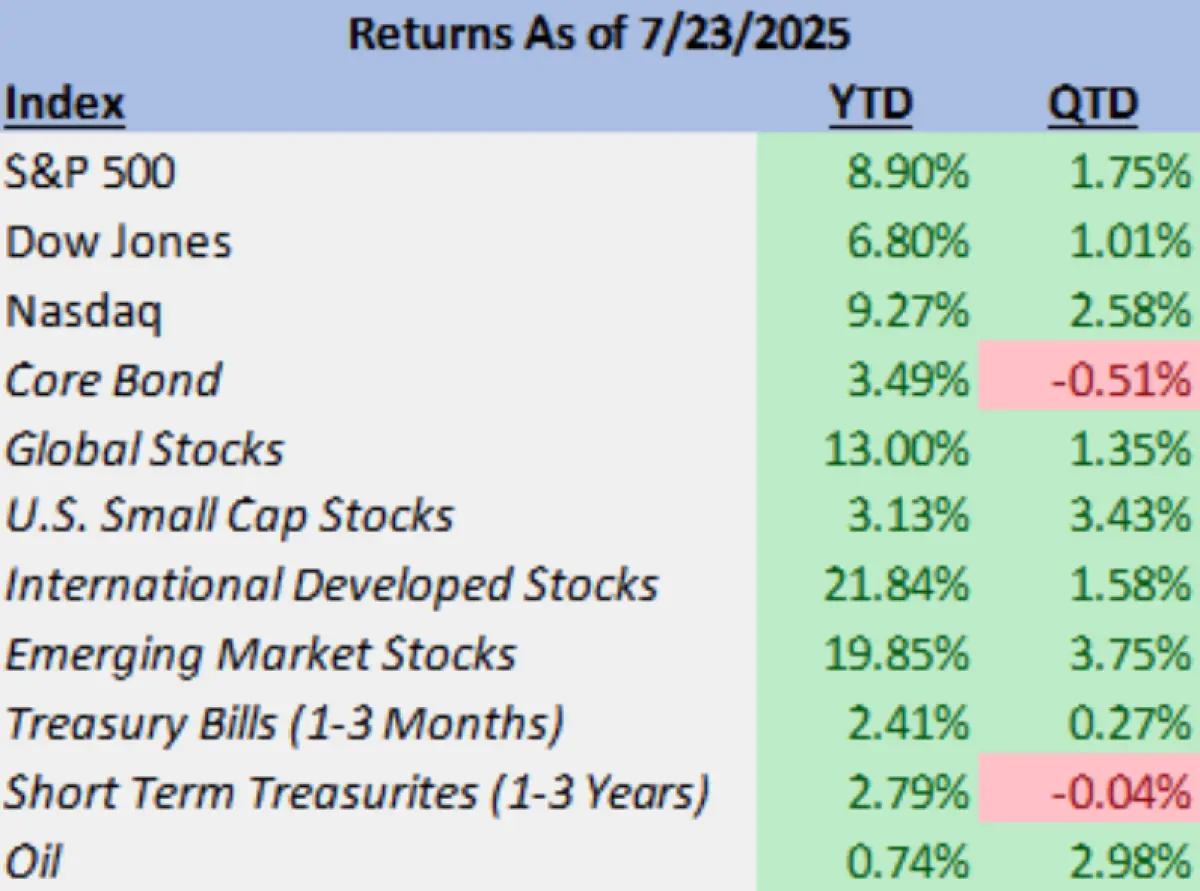
As mentioned in the introduction, the global stock market has not only recovered from its pullback earlier in 2025, but is recently establishing new all-time highs. U.S. large-cap stocks (as measured by the S&P 500) are up 28% from the April lows and have returned 8.9% year-to-date at just past the halfway mark of the year.
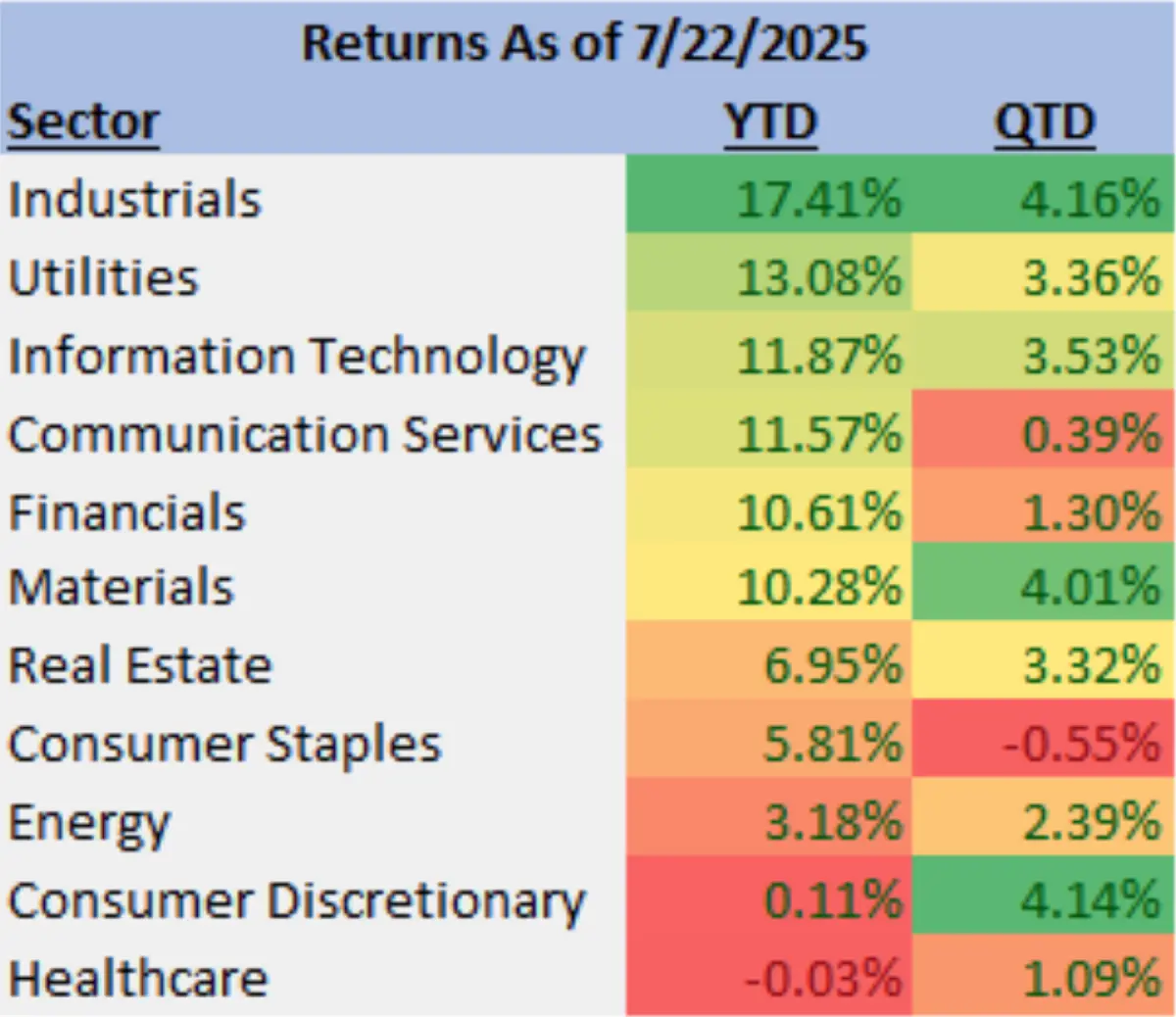
Leadership within the S&P 500 has come from an interesting mix of both traditionally growth-oriented and value/cyclical sectors. Notably, Industrials, Information Technology, Communication Services, Utilities, and Financials have been the top-performing sectors; each returning above 10%, with Industrials leading the way at over 17%.
Several of these – Industrials, Tech, Communication Services, and Financials – are cyclically tied to economic activity, reflecting investors’ renewed risk appetite. Meanwhile, the traditionally defensive Utilities sector largely sidestepped the post-“Liberation Day” tariff-driven slide and has continued to reap benefits from the A.I. investment theme. On the other end of the spectrum, the biggest sector laggards so far have been Healthcare and Consumer Discretionary stocks, which have underperformed (~0% YTD for each) in what has otherwise been a broad market rally.
Smaller-cap U.S. stocks have lagged their large-cap counterparts for most of this year (~3% YTD). Uncertainty around inflation and the timing of future interest rate decreases have been headwinds for small caps, which tend to be more domestically focused and sensitive to financing conditions. However, since the market bottomed in April, small caps have staged a strong comeback, exceeding the large cap recovery during the ensuing rally (~30% since the bottom).
International equities remain a major outperformer on the year (~22% YTD). Even though their momentum has lagged since the U.S. market’s April recovery began, non-U.S. stocks (both developed international and emerging markets) still hold sizeable year-to-date gains in excess of U.S. equities.
This marginal slowdown in performance (still ~23% since the bottom) is somewhat surprising given that the U.S. dollar has continued to weaken over that period, which would normally further boost foreign stock performance – the recent pause could be just a temporary interruption of the earlier trend of international outperformance, or perhaps a reversion toward the longer-term modern track record of U.S. leadership.
Emerging-market equities have also outperformed year-to-date (~20% YTD) and have picked up more momentum since the April bottom (~28%), helped by improving sentiment in key markets. We continue to hold a cautious outlook for this market segment due to their sensitivity to tariff-related pressures and the ongoing trade negotiations process.
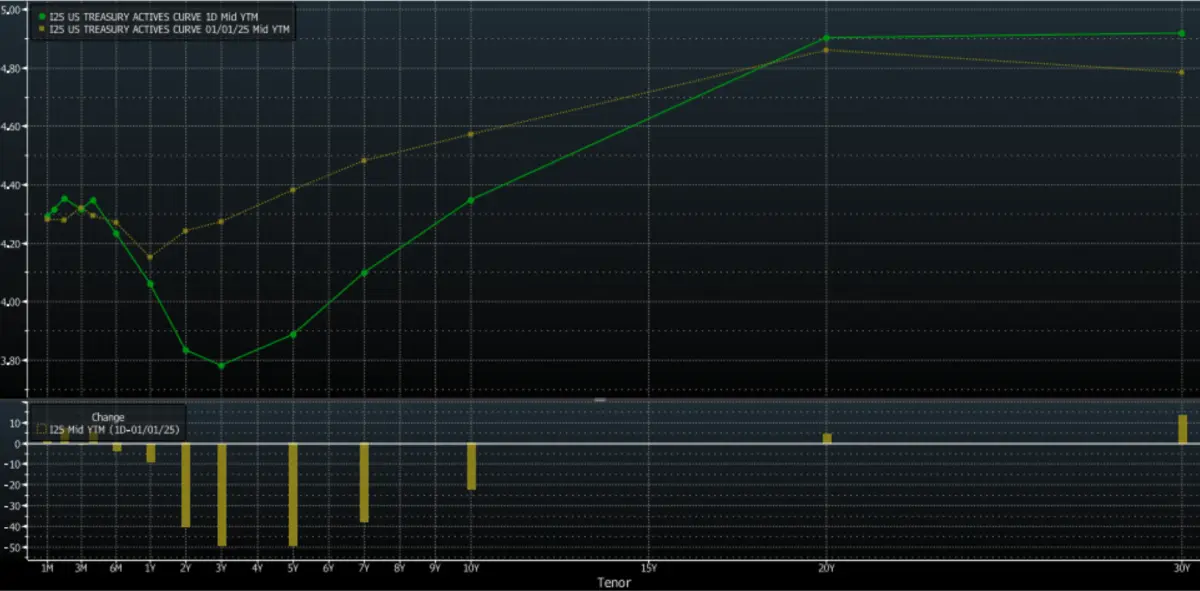
US Treasury Yield Curve- 7/23/2025 compared to 1/1/2025 (Bloomberg)
In the bond market, returns have been mildly positive year-to-date (3.49% for the Barclays US Aggregate Index), but the details differ across the yield curve. As alluded to in the introduction, we have seen a divergence in yields depending on maturity. Rates on U.S. Treasuries in the 6-month through 10-year range have fallen since the start of the year (boosting prices for those bonds), whereas yields in the 20-year and longer segment have risen over the same period.
A steepening of the yield curve from long-term rates climbing is economically normal in an expanding economy, but it may also reflect investors’ concerns about longer-run inflation expectations and rising risk premia (whether driven by the growing U.S. deficit or political stability worries).
The rise in long-term yields has real economic implications: it increases the government’s borrowing costs given the current deficit, and it adds pressure to a struggling housing market by keeping mortgage rates elevated. In contrast, the decline in short- and intermediate-term yields suggests bond investors believe policy rates have peaked and inflation will be contained, at least in the nearer term.
Earnings Season
The second-quarter corporate earnings season is still in its early stages, and it will come into greater focus as we move through late July. Thus far, only 121 of the S&P 500 companies have reported results, 35 of those being in the Financials sector.
It’s too early to paint a full portrait of overall earnings, but the early indications – especially from major banks – have been encouraging.
The big banks that have reported have shown continued loan growth and deposit stability, evidence that households and businesses remain active borrowers and that the financial system is still on solid footing. The financial sector as a whole is off to a strong start this earnings season, with the reporting companies beating consensus estimates by 2% on revenues and ~11% on earnings (upside surprises in both top-line and bottom-line results).
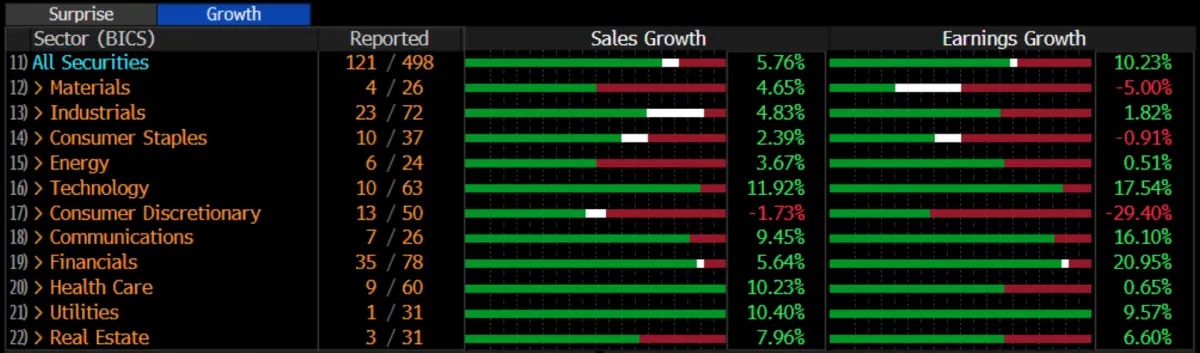
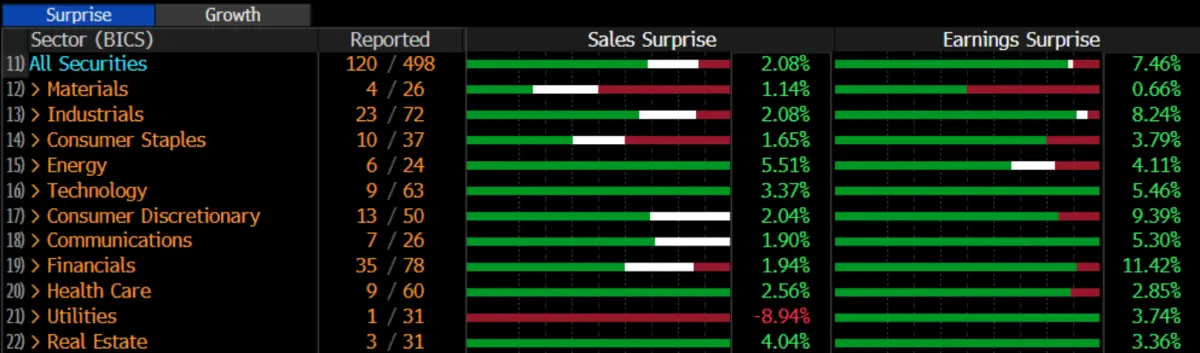
S&P 500 Sales and Earnings Data- As of 7/22/2025 (Bloomberg)
Further evidence of consumer strength can be seen in results from the travel and leisure industry. For example, Carnival Corporation reported record quarterly revenue of approximately $6.3 billion for Q2, reflecting robust demand for cruises. Consumers’ willingness to spend on travel experiences has helped companies like Carnival deliver results that exceed pre-pandemic levels, an impressive feat and a positive signal for the broader discretionary spending outlook.
Much more will be gleaned as we get deeper into earnings season in the coming weeks. We won’t have to wait long for some of the biggest potential market-moving reports: the bulk of the “Magnificent 7” stocks – including Microsoft (MSFT), Apple (AAPL), Meta (META) who are yet to report– are set to finish reporting by the first week of August. These mega-cap tech and tech-adjacent companies have been key drivers of the market’s gains, so investors will be keenly focused on their results and guidance.
Netflix provided its earnings results last week and the company beat expectations on both the top and bottom line. The streaming giant also raised its full-year revenue forecast and operating margin target, citing growth in subscriptions and ad revenues.
This is just another piece of evidence of an economy that continues to be driven by a willing consumer. Google parent company, Alphabet, also exceeded earnings expectations for the second quarter with resilient beats in YouTube advertising revenue and Google Cloud revenue. They also upped their forecast for capex spending on artificial intelligence. Tesla meanwhile became the first Mag 7 company to report slight misses on EPS and revenue estimates; automobile related revenue fell for a second straight quarter.
According to FactSet’s latest Earnings Insight report, the S&P 500 is expected to post year-over-year earnings growth of about 5.6% in Q2 (Factset). If that growth rate is realized, it would be the index’s weakest earnings growth since Q4 2023 (which saw 4.0% YoY growth).
However, it’s important to note that actual earnings results often beat the estimates to some degree. In fact, over the past ten years S&P 500 companies have, on average, reported earnings about 6.9% above analysts’ estimates. If that historical pattern holds this quarter, the final earnings growth for Q2 could end up being substantially higher – potentially into the high single digits or above.
In short, while earnings growth may appear modest on the surface, there is a reasonable likelihood that the “real” earnings picture will come in stronger than expected once all companies have reported. At this point in time, this has been the case. Of the 121 companies from the S&P 500 having reported, earnings growth has averaged at 10.23% year-over-year for the quarter.
Tariffs
U.S. tariff policy remains a central theme for the markets, though recent actions have provided a bit more clarity in the near term. The sweeping “Liberation Day” tariffs announced in early April – which imposed a baseline 10% duty on imports from virtually all U.S. trading partners, with much higher rates for specific countries based on trade imbalances – were initially put on hold with a 90-day pause to allow for negotiations.
That pause was set to expire on July 9, but in the final hours it was extended. President Trump signed an executive order delaying the deadline for re-imposing the country-specific tariffs until August 1, 2025.
This extension has started to provide at least some proof of concept, most notably a trade deal struck yesterday with Japan. The full details remain unclear, but the announcement includes a 15% tariff rate on imports from Japan and a $550M investment commitment. As the nation’s fifth largest trading partner ($227.9B estimated in goods trade), this represents a significant development in the current trade negotiations progress.
In terms of tariff impacts to date, June’s inflation numbers did show a bit of an uptick (as discussed below), suggesting that some tariff pass-through might finally be materializing in certain categories.
In general, the tariff-driven price increases have been surprisingly limited, thanks to factors like companies drawing down pre-tariff inventories and businesses choosing to absorb costs for now (CBS). This is good news in the short run for inflation, though it raises questions about how long firms can continue to absorb costs if tariffs remain in place for the long run.
Economic Update
The U.S. economy is being closely watched for signs of re-acceleration or further cooling as we move into the second half of the year. The advance estimate for second-quarter GDP is scheduled for release on July 30, and it will be especially scrutinized after the first quarter of 2025 showed a modest GDP decline of –0.5%.
That Q1 contraction was largely attributed to a drag from net exports – in particular, U.S. businesses had front-loaded imports in anticipation of the Liberation Day tariffs, causing a surge in imports that subtracted significantly from Q1 growth.
Many economists expect that effect to prove temporary and to potentially be reversed in Q2. In fact, the latest real-time forecast from the Atlanta Federal Reserve’s GDPNow model is projecting a bounce-back in growth for Q2.
As of mid-July, the GDPNow model estimates second-quarter real GDP growth at roughly 2.4% annualized (atlantafed), up from the slight decline in Q1. This estimate has been revised down a bit from earlier in the month (it was 2.6% as of July 9), but it still points to a solid rebound.
The model suggests that trade is swinging from a headwind to a tailwind in Q2 – net exports are forecast to contribute about +3.3 percentage points to growth (after a negative drag in Q1) – while consumer spending remains resilient with an estimated +1 percentage point contribution.
We saw evidence of that resilience in the June retail sales report released this week, which showed consumer spending was stronger than expected: retail sales rose 0.6% in June from the prior month, handily beating the consensus forecast of 0.1%. This rebound in spending (after a dip in May) suggests the American consumer is still in the game, supported by a healthy job market.
Housing starts and consumer sentiment (via the U of Michigan Sentiment Survey) beat estimates as well with ~1.32M housing starts reported for June (est. 1.3M) and sentiment gauged at 61.8 (est. 61.5).
Inflation in the U.S., while off its highs over the past few years, remains a focal point. The June Consumer Price Index (CPI) data showed a pickup in inflation from the very low levels seen in May. On a year-over-year basis, headline CPI increased 2.7% in June, and on a month-over-month basis headline prices rose 0.3% from May to June.
These figures were just slightly above what economists had expected (consensus was around 2.6% YoY and 0.3% MoM), indicating inflation came in a touch hotter than forecast. The acceleration from May’s numbers (which were 2.4% YoY and only 0.1% MoM) was notable, but still representing overall progress from the 5–9% readings we saw at various points in the last three years.
A bright spot in the report was that core inflation (which excludes food and energy) reported at lower than forecasted numbers. Core CPI was 2.9% year-over-year in June, exactly in line with expectations and up slightly from 2.8% in May.
On a monthly basis, core prices rose 0.2% in June, a tad below the 0.3% consensus expectation and only a minor uptick from May’s 0.1% increase. In other words, underlying price pressures (stripping out volatile fuel and food costs) are rising at a roughly 0.2% monthly pace, which would be around 2.4% core inflation annualized.
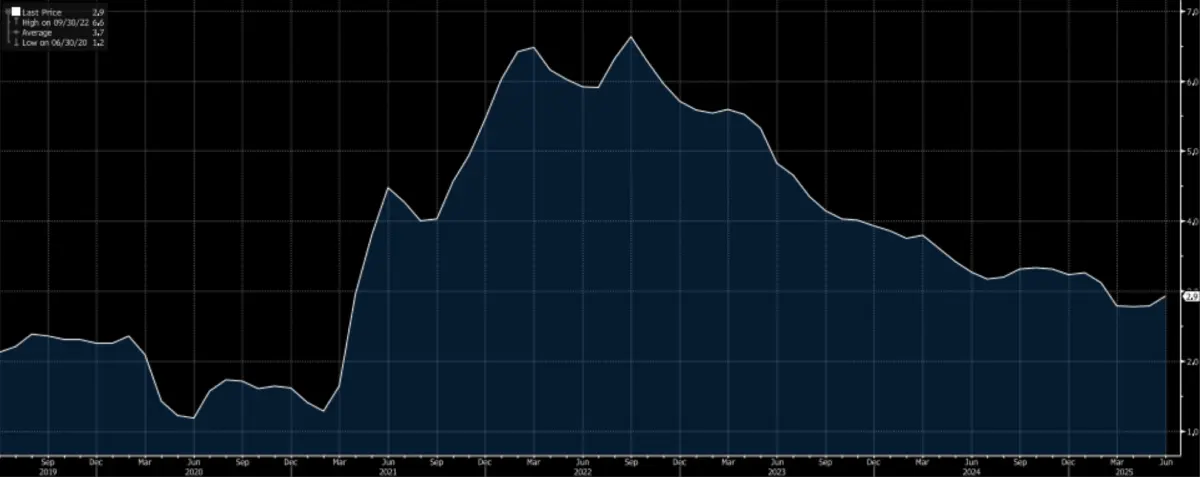
US CPI ex Food and Energy- As of June Data (Bloomberg)
Within the June data, both core goods and core services saw some price firming compared to May. This was largely driven by medical care and transportation services on the services side and for goods, a rise in prices for transportation related commodities (new and used vehicles, motor vehicle parts) and household furnishings.
The key takeaway is that inflation remains moderately above the Fed’s long-run 2% target, but it is vastly improved from the high levels of 2022–2024 and is trending in the right direction overall. The June data did break a string of cooler-than-expected inflation prints, so we will watch upcoming reports to see if this is the start of a slight re-acceleration due to tariffs or other factors, or just normal volatility in the disinflation process.
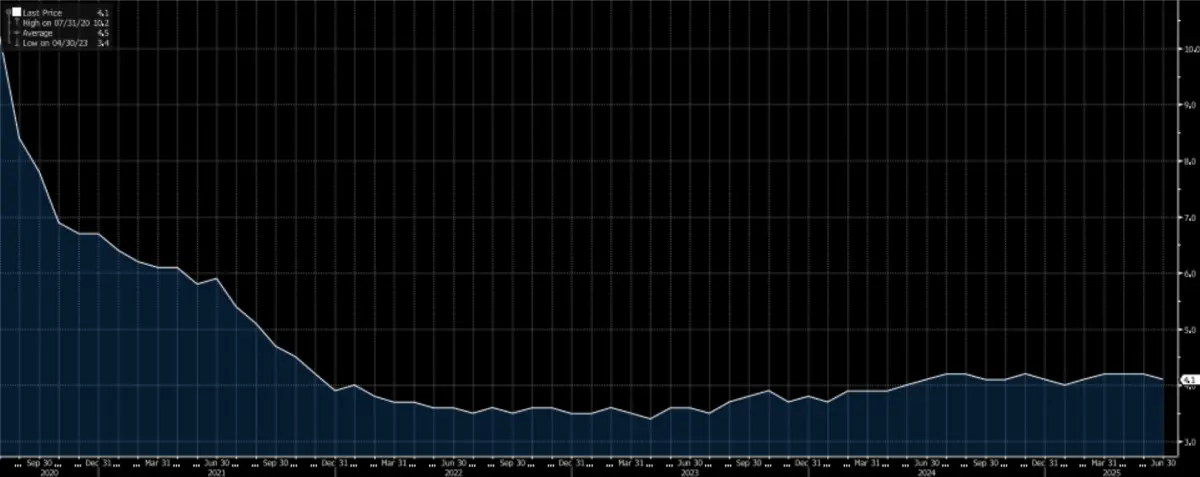
US Unemployment Rate- As of June Data (Bloomberg)
The first days of July brought a pair of starkly different signals on the U.S. labor market, illustrating the difficulty of interpreting the economy’s crosscurrents.
Private payroll processor ADP’s Employment Change report for June (which measures private-sector job growth based on ADP’s client payroll data) shocked markets by showing a net loss of 33K jobs in June, versus economists’ expectations for a gain of around +98K.
This was the first negative ADP print in over two years, raising concerns that hiring might be suddenly stalling out.
However, the very next day the official government non-farm payrolls report told a much more upbeat story: the U.S. economy added 147K in June (better than the ~106K consensus forecast) and the unemployment rate ticked down from 4.3% in May to 4.1%.
How can we reconcile these two reports?
It helps to understand that ADP and the Bureau of Labor Statistics (BLS) use very different sources and methods. ADP’s report is derived from the company’s private payroll data and covers only private-sector employment, whereas the BLS non-farm payrolls report is based on large government surveys of businesses (for payrolls) and households (for the unemployment rate), and it includes both private and public sector jobs.
The two reports often diverge, ADP’s numbers have little correlation with the official payroll figures (Reuters) – in some months ADP undershoots, in others it overshoots. In simple terms, ADP is a useful guess at the trend but not a reliable predictor of the actual non-farm payroll jobs report.
In June’s case, the discrepancy was huge: ADP indicated a pullback in private hiring, while the BLS data showed solid gains (including a boost from government hiring, especially at the state level, which ADP wouldn’t capture).
It’s worth noting that even within the robust official report, there were a few signs of cooling: private-sector payrolls were up a more modest +74K (vs. +100k expected) and the manufacturing sector shed 7K jobs in June.
Those details suggest some pockets of weakness despite the overall strength.
Broadly speaking, the U.S. labor market remains healthy and tight. Job growth, while slower than last year’s torrid pace, is still positive; unemployment at 4.1% is historically low; and wage gains, though easing, are still running above 3% year-on-year. This continued labor market strength is a reassuring sign for the economy, as it underpins consumer spending and confidence.
The Fed
All eyes are on the Federal Reserve as it approaches its July 30th policy meeting. Market participants overwhelmingly expect the Fed to leave interest rates unchanged at this meeting, maintaining a federal funds target rate of around 4.5% for what would be the sixth consecutive meeting.
Fed Chair Jerome Powell has made clear that while inflation has come down, it is not yet at the comfortable level that would warrant easing – especially given the continued strength of the labor market and the uncertainty over tariff policy’s impact. In recent public remarks, Powell and other Fed officials have pointed to solid job gains and ultra-low unemployment as evidence that the economy is handling higher rates, and they have expressed caution about cutting rates prematurely while tariff-related risks to inflation linger.
Essentially, the Fed wants to see more definitive evidence that inflation will stay around 2% or that growth is faltering before it considers rate cuts. With the economy proving resilient so far, the bar for a cut remains moderately high in the near term.
While Fed policy itself remains front and center for investors, there has been no shortage of drama and speculation around the Federal Reserve’s leadership and independence as well. The Presidential administration has expressed very public criticism of Chair Powell in recent months, with the President repeatedly urging the Fed to cut rates and even entertaining the idea of replacing Powell.
Powell’s term as Fed Chair ends in February next year, and there is widespread conjecture about who might be tapped to lead the central bank next. Our view is that the scenario of the President actually firing Powell before his term is up remains highly unlikely (such an action would be unprecedented and legally questionable).
If an early ouster did occur, however, it could spark significant short-term volatility in both equity and bond markets.
Investors would likely fear that a more politically malleable Fed might shift to an overly dovish policy stance despite inflation still running above target. There would also be broader concerns about the perceived erosion of the Fed’s political independence – a perceived cornerstone of its credibility.
Our base case, again, is that this remains a very low-probability tail risk. Even if this were to happen, or the Fed Chair were to step down on his own due to the pressure, we believe any market volatility would be relatively short-lived.
The Fed’s policy decisions are made by the 12-member Federal Open Market Committee (FOMC) via majority vote, not by the Chair alone. That committee structure provides continuity and some insulation from any one individual’s influence.
So, a change at the top – especially if it meant installing a more dovish voice favored by the administration – could marginally tilt the committee’s center of gravity, but it wouldn’t outright overturn the Fed’s collective approach. Any new Chair would still have to carry a majority of the FOMC to implement policy changes.
In practical terms, though, replacing Powell with someone far more dovish could speed up the timeline for rate cuts, because it might sway the internal debate and voting balance in favor of easing. Markets are very aware of this possibility, however remote, and it’s one reason any rumors on this topic moves prices.
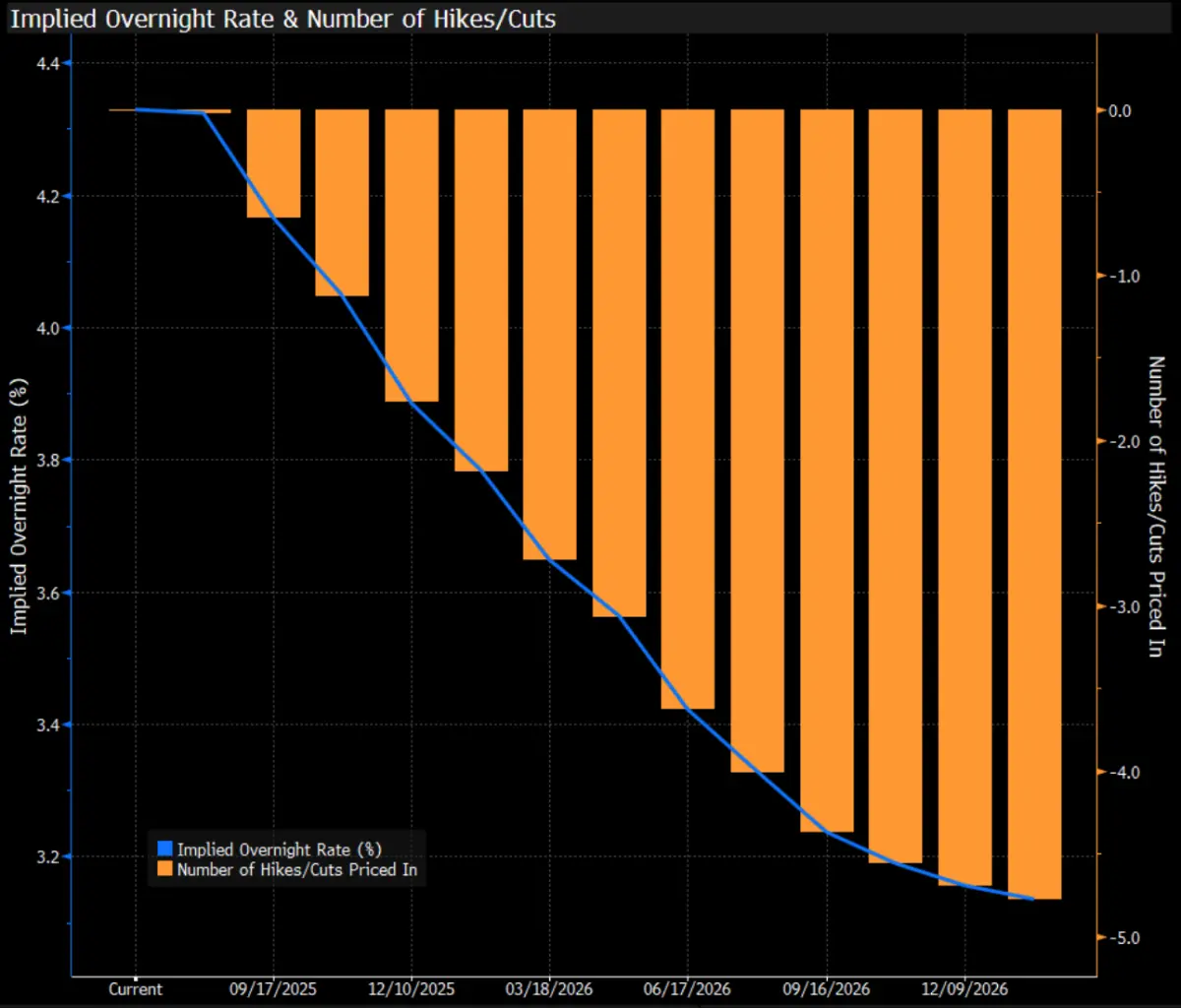
Fed Funds Futures Market Implied Overnight Rate & Number of Cuts/Hikes (Bloomberg)
As it stands now, market pricing in the Fed Funds futures reflects an expectation of ~1.7 quarter-point rate cuts by the end of 2025. In other words, investors are betting that the Fed will begin easing later this year – most likely by the September or October FOMC meetings – and then partially pricing in one additional 25 bps cut sometime after by year-end. This aligns with the idea that the first cut is likely coming in the fall if inflation continues to trend down and growth softens modestly.
Of course, this is just the current market-implied path; the Fed’s own “dot plot” from June suggested that many Fed officials weren’t penciling in any cuts until 2026. The reality will depend on the data.
If the economy maintains momentum and inflation stays around the mid-2% level or higher, the Fed could delay cutting until very late this year or even into next year. If inflation moderates further, the Fed will likely institute at least one rate cut by the end of the year. Conversely, if we see a sharper slowdown or a financial shock, the Fed has room to respond sooner and with more aggression.
Conclusion
In summary, our view is one of cautious optimism. The economy has navigated significant challenges – from a trade-tariff showdown and political uncertainty to inflation and rate fears – and has emerged still standing and, in some areas, thriving. Markets have rewarded this resilience with a strong rally to new highs, yet we remain mindful that risks have not vanished: trade negotiations are entering a critical stretch, inflation is much improved but not yet at goal, and the Fed is carefully walking a tightrope.
In this environment, a balanced and flexible investment approach remains prudent. We will continue to monitor developments closely and adjust our outlook as conditions warrant, confident that a well-diversified strategy tailored to one’s investment tolerance will serve investors well in the second half of 2025 and beyond.
Need Some Help?
If you’d like some help from one of our CPAs or CERTIFIED FINANCIAL PLANNER (CFP®) advisors regarding this strategy and how it applies to you, the Rhame & Gorrell Wealth Management team is here to help.
Our experienced Wealth Managers facilitate our entire suite of services including financial planning, investment management, tax optimization, estate planning, and more to our valued clients.
Feel free to contact us at (832) 789-1100, [email protected], or click the button below to schedule your complimentary consultation today.

IMPORTANT DISCLOSURES:
Corporate benefits may change at any point in time. Be sure to consult with human resources and review Summary Plan Description(s) before implementing any strategy discussed herein.Rhame & Gorrell Wealth Management, LLC (“RGWM”) is an SEC registered investment adviser with its principal place of business in the State of Texas. Registration as an investment adviser is not an endorsement by securities regulators and does not imply that RGWM has attained a certain level of skill, training, or ability. This material has been prepared for informational purposes only, and is not intended to provide, and should not be relied on for, tax, legal or accounting advice. You should consult your own CPA or tax professional before engaging in any transaction. The effectiveness of any of the strategies described will depend on your individual situation and should not be construed as personalized investment advice. Past performance may not be indicative of future results and does not guarantee future positive returns.
For additional information about RGWM, including fees and services, send for our Firm Disclosure Brochures as set forth on Form ADV Part 2A and Part 3 by contacting the Firm directly. You can also access our Firm Brochures at www.adviserinfo.sec.gov. Please read the disclosure brochures carefully before you invest or send money.