

Market Update – September 2025
As the end of September quickly approaches, so does the beginning of the final quarter for what has been an overall strong 2025 for markets. Despite the headwinds of stubbornly sticky inflation and growing evidence of a weakening labor environment, equity markets have not only continued to new all-time highs but also appear to be broadening out in strength. Likely playing a key role in this dynamic has been a shift in expectations towards moderating monetary policy. Last week, the Federal Reserve provided their first actions in affirming this market sentiment, cutting the benchmark interest rate by 0.25% at their September meeting. The next day, small cap stocks (per the Russell 2000 index) followed up this news by closing at their first new all-time high since November 2021. While growth oriented large cap domestic equity indices (such as the S&P 500 and NASDAQ 100) have seen their valuations grow significantly since their recent lows in 2022, other equity subsets (small caps, international developed markets, and emerging markets) remain at or below their valuation levels exhibited in the pre-COVID era. If inflation risks continue to be subdued, then a more moderate Fed is likely to maintain its recent dovish pivot and in turn economic growth can remain resilient. This backdrop could see a follow-through of the year’s broadening out in equity market performance.
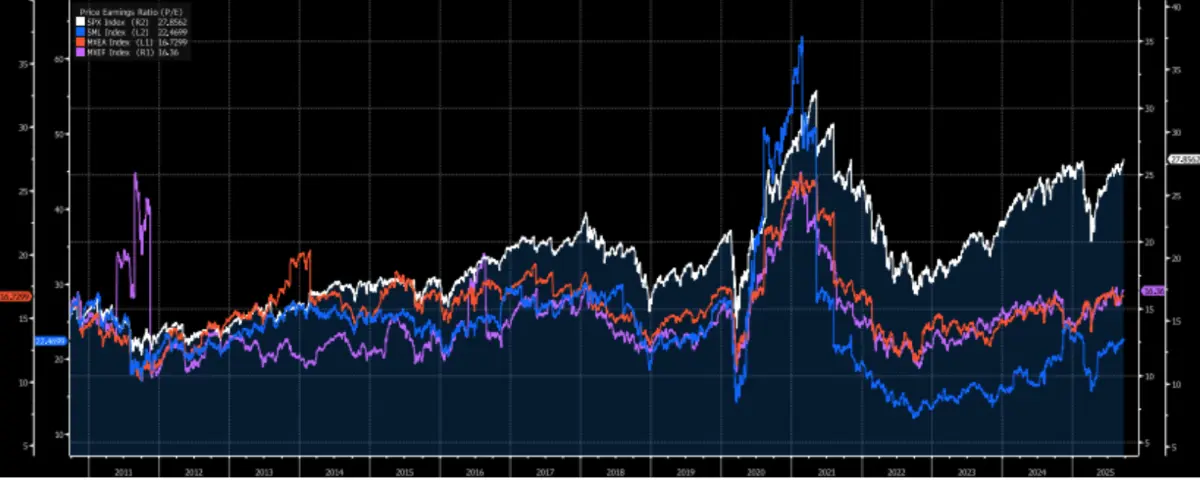
Price-To-Earnings Ratios for Equity Indices from 2011-2025 (as of 9/23/2025)- Bloomberg
Market Summary
September has seen a continuation of the strong rally in stocks from their April lows. The S&P 500 has returned nearly 14% year-to-date with an ~7% gain in the third quarter alone. Helping propel these returns has been leadership on the sector level from the communications services (~26% YTD) and technology sectors (~20% YTD). Both industrials (~16.50%YTD) and the traditionally defensive utilities (~16% YTD) sectors have also provided outsized returns for the large cap equity index.

While lagging the overall index year-to-date, consumer discretionary stocks have seen a strong resurgence in recent months, returning ~9.50% for the quarter. Healthcare (~0.50% YTD), consumer staples (~4.20% YTD), and real estate (4.70% YTD have continued to lag the broader S&P 500 on both a year-to-date and monthly basis.

Joining the S&P 500 in reaching a new all-time high are U.S. small cap stocks (Russell 2000 index). Last week marked the first all-time high for the asset class since before the bear market in 2022. Small caps continue to lag large caps year-to-date (~10% YTD) but have rallied dramatically this quarter with a ~12% return. The Fed’s recent dovish pivot and rising earnings expectations (both detailed later) have been supportive catalysts in the rally for small cap stocks.
Outside of the U.S., market performance has also been impressive. Both international developed (~24% YTD) and emerging market stocks (~28% YTD) have outperformed their domestic counterparts. While the returns from developed market equities (~4% QTD) have slowed in recent months, the rally in emerging markets (~11% QTD) has accelerated. Expectations for lower global interest rates and a weakening dollar continue to be tailwinds for these market segments.
Bonds have also continued to provide positive returns on a year-to-date basis, with the Bloomberg U.S. Aggregate Bond Index currently returning ~6% YTD. Rates across the yield curve have fallen over the year, with intermediate maturities (1-10 years) seeing the most substantial downward shifts in the steepening process.
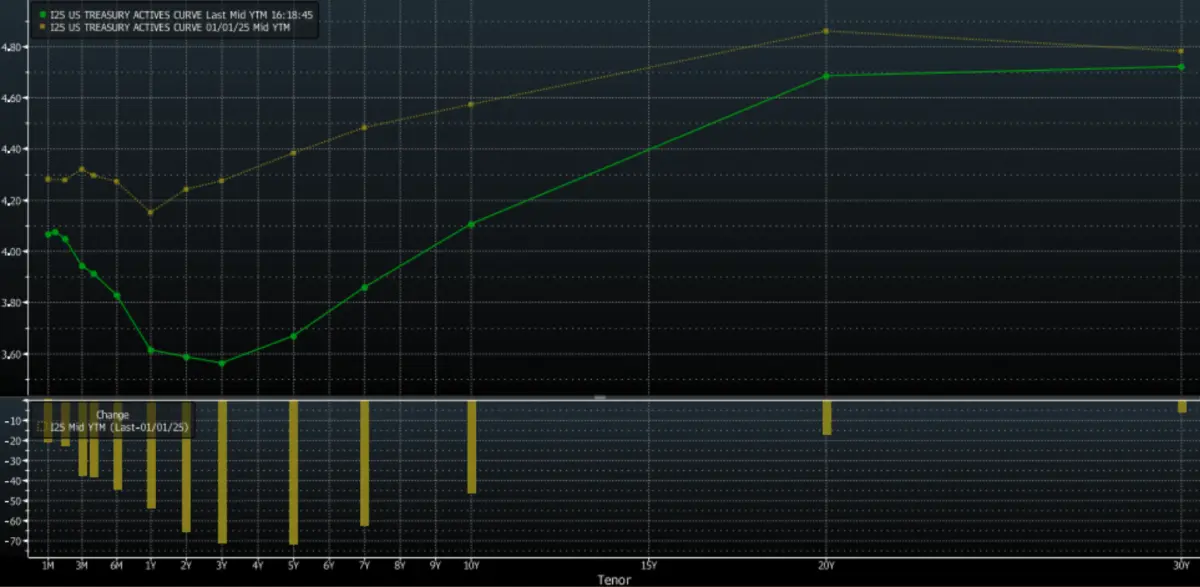
U.S. Treasury Yield Curve and Spreads (9/23/2025 relative to 1/1/2025)- Bloomberg
The Fed’s Dovish Pivot
As mentioned in our introduction, last week saw the Federal Reserve cut the benchmark Federal Funds Rate by a quarter point from a range of 4.25%-4.5% to 4%-4.25%. It was the first adjustment in interest rates from the central bank in nine months. Markets had largely priced in a cut following this year’s Jackson Hole Economic Symposium in August, where Fed Chair Jerome Powell all but broadcasted during his address that an interest rate cut would be arriving at the next FOMC meeting. The 10-year Treasury yield fell ~0.3% in the weeks leading up to the September announcement. Interest rate futures markets had more than fully priced in a cut on the day prior to the meeting.
Since the cut and Jerome Powell’s post announcement press conference, bond prices have seen a pause in the rally with the 10-year Treasury yield moving back above 4% to a range of ~4.1%-4.15% in recent days. While the central bank’s chairman indicated that additional cuts over the remainder of the year would be appropriate, the FOMC’s latest “Dot Plot”, which provides a compilation of the committee member’s interest rate forecasts, shows a high degree of dispersion in opinion in the rate trajectory for 2026. The median of projections implies just a single rate cut for the upcoming year after two more cuts in 2025.
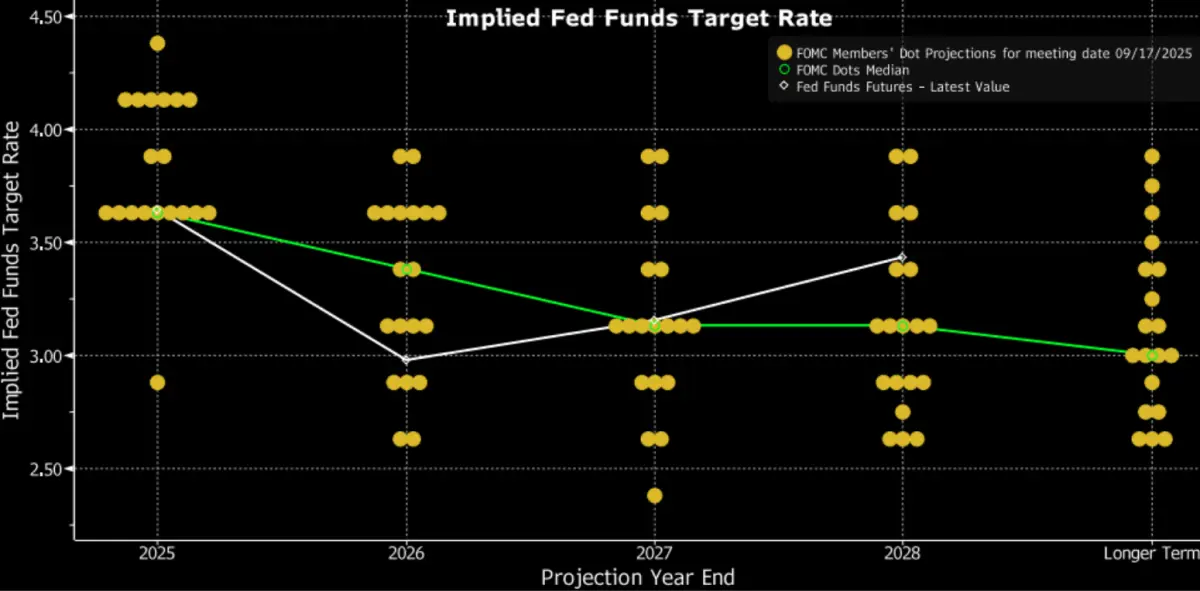
Federal Reserve Dot Plot (September Meeting)- Bloomberg
When one compares these projections to the expectations priced in by interest rate futures markets, there appears to be a moderate disconnect, with the market seeing two additional cuts in 2026. Perhaps an even more intriguing and more recently impactful disconnect exists in the markets longer-term expectation for policy rates (2028 specifically). Over this time horizon the market is currently pricing fed funds futures rates to be higher than in 2026. A number of factors could influence this implied rate level, ranging from market structure (such as liquidity) to legitimate uncertainty over expectations for future risk factors (inflation, budget deficits, term risk premia). This uncertainty, alongside the Fed’s own modest projections of future rate cuts, could potentially act as a barrier and prevent longer-term Treasury yields from moving substantially lower.
Economic Summary
While easing monetary policy is a potential positive tailwind for equity markets, it is equally important for the economy to maintain a growth trajectory for a broadening stock market rally to continue. After an alarming moment of negative growth in the year’s first quarter that was largely driven by a tariff induced import rush, the second quarter saw a significant recovery partly driven by a reversal of the same factors. With the bulk of these tariff outlier impacts settled, the third quarter’s advanced GDP estimate next month will likely provide a clearer indicator of the economy’s current health. The Atlanta Fed’s GDPNow model is presently forecasting real GDP for the third quarter to be 3.3%. The model is tracking for the all-important component of consumer spending to contribute 1.85% to overall GDP.
Helping paint this rosy third quarter projection has been a resiliency of retail sales which is a key part of overall consumer spending. After two consecutive negative monthly reports in April and May, retail sales have bounced back with a series of three positive months. The most recent report for August retail sales showed a 0.6% month-over-month increase that was double the consensus economic estimate. This was largely driven by a greater than expected increase in online sales. Also surprising economists in August was a stronger than expected recovery in Industrial Production. After a -0.1% decline in July, August defied estimates of another decline with a 0.1% positive report. The upside beat was delivered through a recovery in mining output and production of motor vehicles. Further signaling economic stability is the data from PMI reports which are viewed as leading indicators. The S&P Global PMI reports for August showed both US Manufacturing and US Services PMIs with index values of greater than 50; PMI values greater than 50 indicate expansionary activity. The ISM PMI surveys were mixed, with services indicated as in expansion (52) and manufacturing contracting (48.7). The ISM Manufacturing PMI report has delivered slightly contractionary figures since February, so this does not suggest a substantial change. Overall, we view the composition of these growth-related data points as constructive for economic activity in the third quarter.
Recent inflation data delivered a mixed message for markets. On the producer side, the August Producer Price Index (PPI) surprised to the downside, declining 0.1% both overall and excluding food and energy, versus expectations for a 0.3% gain in each measure. On a year-over-year basis, PPI rose 2.6% and 2.8% ex food and energy, well below economist forecasts of 3.3% and 3.5%. This suggests that pricing pressures at the wholesale level are cooling faster than expected. On the consumer side, the Consumer Price Index (CPI) was more in line with forecasts. Headline CPI rose 0.4% month-over-month, with core CPI (which strips out food and energy) advancing 0.3%. Year-over-year, headline inflation registered at 2.9% and core inflation at 3.1%, both consistent with consensus expectations. Taken together, these reports show some encouraging signs of easing pressures at the producer level, while consumer prices remain elevated but relatively stable.
Despite these developments, the broader picture continues to highlight sticky inflation expectations. The 10-year Treasury breakeven inflation rate—a widely watched market measure of expected inflation—has climbed from a September 2024 low of roughly 2.04% to about 2.36% today. This upward move reflects investor skepticism that inflation will fall rapidly back toward the Federal Reserve’s 2% target, even as tariffs appear to be exerting less upward pressure than feared.
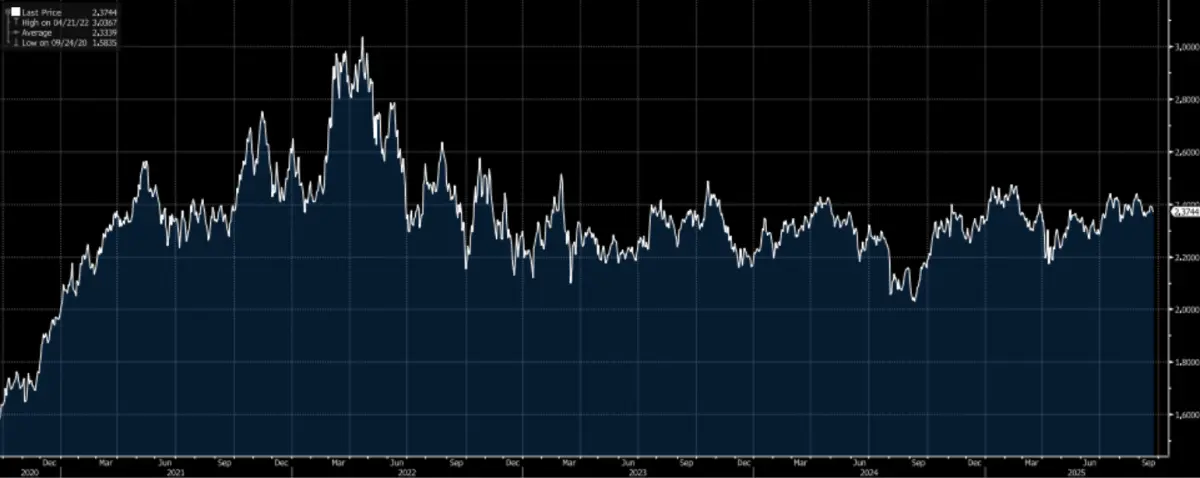
10Y Breakeven Treasury Yield (9/23/2025)- Bloomberg
The Fed’s decision to begin loosening monetary policy introduces additional uncertainty, as easier conditions could allow inflation to remain stubborn or even reaccelerate if growth proves resilient. While our base case is not for inflation to substantially reaccelerate, we do see resilient economic growth and less restrictive monetary policy as likely keeping the inflation range bound near current levels over the short-term.
Labor Market
Guiding the Federal Reserve in its recent decision to cut interest rates has been continuing signs of weakness in the labor environment. The August payrolls report, released earlier this month, provided additional evidence of a stalling jobs market. The report for nonfarm payrolls showed only 22,000 jobs added for August. This was below the consensus forecast of 76,000 jobs and below the revised July report of 79,000 jobs. When taking into account the revisions, the last four monthly nonfarm payroll reports have shown net job changes of 22K, 79K, -13K, and 19K amounting to just 107,000 jobs added total in the period. Prior to this stretch, the labor market had been exhibiting job additions totaling well over that sum each month.
A silver lining to this concerning labor market dynamic is that while job creation/additions have slowed, layoffs have not yet exhibited a significant pickup. Initial jobless claims remain in their normal range and the unemployment rate has only moved marginally higher to 4.3% (in-line with estimates) than its prior level of 4.2%. Driving the rise in unemployment has not been firings, but has instead been a combination of new entrants who had been outside the labor force returning and a slowdown overall in new hires for those looking for new jobs.

Initial Jobless Claims (as of 9/12/2025)- Bloomberg
This suggests that demand for labor has not collapsed, but that the market continues to cool. While loosening of monetary policy may provide labor market support further in the future, factors such as uncertainty regarding economic growth and consumer strength, as well as recent downsizing in segments of the federal workforce, are likely to maintain this cooling effect on the labor market in the near-term.
Broadening Out
A theme that has been present throughout this update has been the topic of the “broader” rally that has been exhibited across the stock market in recent months and whether it is representative of a longer-term trend or simply an interruption of what had been a market dominated by U.S. mega caps over the last decade. There have been many moments of strength in other parts of the market, ranging from small cap stocks to international equities, that ultimately saw their outperformance fade before a return to U.S. large cap leadership. So, this begs the question of why this time it might be different.
At least in the short-term there are signs that the fundamentals driving corporate performance may favor sustainability in the performance for both small cap equities and emerging market stocks. After a five-year period mostly defined by U.S. large cap dominance in quarterly revenue growth performance, expectations are for convergence from other market segments. Current estimates are for small caps and emerging market equities to outperform in sales growth the S&P 500’s constituents over the next several quarters.

Actual/Expected Growth in Quarterly Revenue of Equity Indices (9/23/2025)- Bloomberg
Earnings growth among the indices is also expected to remain competitive over the next several quarters, with small caps in particular holding expectations for sizable earnings growth through 2026.

Actual/Expected Growth in Quarterly EPS of Equity Indices (9/23/2025)- Bloomberg
All of this remains hinged to overall economic health, as small cap stocks and emerging market equities in particular are highly sensitive to the economic cycle. Lower interest rates, a weakening dollar, and resilient consumer spending are key factors supportive of performance in these asset classes.
Conclusion
Our outlook for markets remains one of balanced optimism. The Federal Reserve’s recent pivot toward moderating monetary policy has helped fuel a broadening of market leadership beyond the large-cap growth names that have dominated in recent years. This diversification of strength across small caps, international equities, and emerging markets provides a healthier foundation for the rally to continue. At the same time, the environment is far from risk-free. Elevated valuations in certain sectors, inflation that has proven more stubborn than many expected, and clear signs of a cooling labor market remind us that headwinds remain in place. The path forward will depend heavily on whether inflation continues to stabilize, how resilient consumer spending proves to be, and the degree to which monetary policy can support growth without reigniting price pressures.
Against this backdrop, we continue to emphasize the importance of maintaining a disciplined and diversified investment approach that aligns with each investor’s long-term goals, risk tolerance, and time horizon. The coming months will bring new information on corporate earnings, economic growth, and geopolitical developments, all of which have the potential to shape market sentiment. Our team will remain focused on carefully monitoring these factors and adjusting our perspectives as conditions evolve. While near-term volatility is to be expected, we believe that patient investors who stay committed to a well-constructed plan are best positioned to navigate the uncertainties of today’s market and participate in the opportunities that arise as the cycle unfolds.
Need Some Help?
If you’d like some help from one of our CPAs or CERTIFIED FINANCIAL PLANNER (CFP®) advisors regarding this strategy and how it applies to you, the Rhame & Gorrell Wealth Management team is here to help.
Our experienced Wealth Managers facilitate our entire suite of services including financial planning, investment management, tax optimization, estate planning, and more to our valued clients.
Feel free to contact us at (832) 789-1100, [email protected], or click the button below to schedule your complimentary consultation today.

IMPORTANT DISCLOSURES:
Corporate benefits may change at any point in time. Be sure to consult with human resources and review Summary Plan Description(s) before implementing any strategy discussed herein.Rhame & Gorrell Wealth Management, LLC (“RGWM”) is an SEC registered investment adviser with its principal place of business in the State of Texas. Registration as an investment adviser is not an endorsement by securities regulators and does not imply that RGWM has attained a certain level of skill, training, or ability. This material has been prepared for informational purposes only, and is not intended to provide, and should not be relied on for, tax, legal or accounting advice. You should consult your own CPA or tax professional before engaging in any transaction. The effectiveness of any of the strategies described will depend on your individual situation and should not be construed as personalized investment advice. Past performance may not be indicative of future results and does not guarantee future positive returns.
For additional information about RGWM, including fees and services, send for our Firm Disclosure Brochures as set forth on Form ADV Part 2A and Part 3 by contacting the Firm directly. You can also access our Firm Brochures at www.adviserinfo.sec.gov. Please read the disclosure brochures carefully before you invest or send money.